
Best Shopify Email Marketing Apps (2026): Complete Comparison, Rankings, Features, Pricing & Expert Recommendations

⏱ 21 min read
Best Shopify Email Marketing Apps (2026): Complete Comparison, Rankings, Features & Expert Recommendations
A definitive industry report for Shopify store owners, DTC brands, ecommerce managers, and retention marketers. Updated October 2026.
Quick Answer: What Is the Best Shopify Email Marketing App in 2026?
Winner. Klaviyo – runs on 43.1% of Shopify stores, recommended by Shopify for Plus merchants, deepest data model and segmentation available at this price point.
Who it’s for. Stores at $300K+ revenue with at least one person managing retention.
Who should skip it. Stores under $100K/year, solo merchants, anyone who won’t invest time in setup. Email pricing starts at $20/month for 251–500 active profiles and climbs steeply with every profile tier (as of October 2026).
Main drawbacks. Aggressive pricing at scale, billing on all active profiles, weak support on non-enterprise tiers.
Runner-up. Omnisend – most of Klaviyo’s everyday ecommerce capability at a lower entry price, with email, SMS and web push in one platform. Best choice for stores under $500K/year.
Detailed Comparison Table
| Klaviyo | Omnisend | Shopify Email | ActiveCampaign | Brevo | Mailchimp | MailerLite | Drip | Sendlane | |
|---|---|---|---|---|---|---|---|---|---|
| Shopify Integration | Excellent | Very Good | Excellent | Good | Good | Good | Good | Very Good | Good |
| Segmentation | Excellent | Very Good | Basic | Very Good | Good | Good | Good | Very Good | Very Good |
| Automation | Excellent | Very Good | Basic | Excellent | Good | Good | Good | Very Good | Very Good |
| Ease of Setup | Good | Very Good | Excellent | Good | Very Good | Very Good | Excellent | Good | Good |
| SMS | Native, billed per message | Native, paid credits | Select regions | Add-on | Native, paid credits | Limited | – | US numbers only | Included |
| Predictive Analytics | Excellent | – | – | Good | – | – | – | Good | Good |
| Price-to-Value | Good | Excellent | Excellent | Good | Excellent | Very Good | Excellent | Good | Good |
| Overall Score /10 | 9.2 | 8.1 | 7.0 | 7.8 | 7.2 | 6.8 | 7.0 | 7.5 | 7.3 |
Decision Matrix: Which Platform for Your Revenue Stage
| Revenue | Platform | Why |
|---|---|---|
| Under $50K/year | Shopify Email or MailerLite | Free or near-free; covers basic flows. Klaviyo’s capabilities go unused at this stage. |
| $50K–$300K/year | Omnisend | Email + SMS + push in one tool with a lower entry price than Klaviyo; compare both calculators at your contact count before committing. |
| $300K–$1M/year | Klaviyo (or Omnisend if cost-sensitive) | Inflection point where predictive analytics and advanced segmentation start generating measurable incremental revenue. |
| $1M–$5M/year | Klaviyo | No serious debate. Software cost is small relative to the revenue flows drive at this stage; the capability gap justifies it. |
| $5M+/year | Klaviyo with suppression strategy | Bills run into the thousands per month at large list sizes. Suppress inactive profiles aggressively, review billing settings after seasonal spikes, negotiate annual contracts. |
What Actually Matters When Choosing an Email Platform
Most merchants make their platform decision based on the wrong inputs: they look at feature lists and pricing spreadsheets and pick the tool that scores highest on paper. In practice, the platform is rarely the decisive variable. The following factors matter far more:
List quality and data hygiene.
A 50,000-contact list with 30% deliverable, engaged subscribers will outperform a 200,000-contact list with 20% engagement – regardless of platform. The first investment should always be in suppression strategy and re-engagement flows, not platform switching.
Automation coverage.
The brands generating 30–50% of email revenue from flows are the ones that have built: welcome series, abandoned cart, browse abandonment, post-purchase, and win-back.
Revenue stage.
A $50K store and a $2M store have fundamentally different tool requirements – see the Decision Matrix above.
Team size and technical expertise.
A powerful platform used at 40% of its capability delivers less ROI than a simpler platform fully utilized. Match the tool to your team’s actual bandwidth, not your aspirational roadmap.
The SMS question.
If SMS is or will become a meaningful revenue channel, evaluate whether you want it bundled with email or managed as a best-in-class standalone. Both are legitimate strategies – the right answer depends on your scale and vendor tolerance.
That is also where a CRO Audit becomes relevant. Picking the right email platform matters, but stores usually gain more when list quality, flows, and on-site conversion issues are fixed together.
How to Choose the Best Email Marketing Platform for Shopify
The best email marketing platform for Shopify is the one that fixes the bottleneck you actually have. Five questions narrow the field:
- What list size will you pay for next year? Klaviyo and Omnisend bill by contacts or profiles, Brevo by email volume, Drip by active people and sends, Shopify Messaging per email beyond its free allowance. Price next year’s list, not today’s.
- Which flows do you need in the next 90 days? If welcome, abandoned checkout and a simple win-back cover it, Shopify Messaging or MailerLite are enough. Browse abandonment, back-in-stock, replenishment and VIP branches push you towards Klaviyo, Omnisend or Drip.
- Do you need SMS, and where are your customers? SMS coverage differs by country: Klaviyo supports the US, Canada, the UK and much of Western Europe, Drip’s SMS is limited to US numbers, and Shopify Messaging offers SMS marketing only in selected regions.
- Who will run it, and for how many hours a week? Under five hours: pick the simplest tool that covers your flows. A dedicated retention marketer: pick the deepest data model you can afford.
- How will you judge revenue? Each platform uses its own attribution window, so figures from two tools aren’t directly comparable. Fix your window before migrating.
| If this describes you | Shortlist | Why |
|---|---|---|
| New store, mostly campaigns, tight budget | Shopify Messaging, MailerLite | Free tiers, near-zero setup |
| One-person team, email and SMS in one tool | Omnisend | Pre-built ecommerce workflows, 24/7 support on all plans |
| Growing DTC brand with a retention owner | Klaviyo | Deepest Shopify data model, segmentation and predictive analytics |
| Hybrid DTC and B2B with a sales pipeline | ActiveCampaign | Automation depth plus CRM (pipelines as add-on) |
| Budget-first, multichannel incl. WhatsApp | Brevo | Unlimited contacts, volume-based pricing |
| US-focused brand wanting ecommerce automation at a lower entry price | Drip | Ecommerce-first workflows, simple pricing model |
One caveat: if flows are live and the list is clean but revenue per session stays flat, the constraint is on-site, and Shopify conversion rate optimisation usually pays back before a platform switch does.
Shopify Email plus an SMS app, or one platform for both?
Two tools are cheaper while SMS covers a few order updates and promotions. One platform wins once SMS should fire only when an email didn’t convert: that needs a single customer profile and shared suppression, or customers get the same message twice. When SMS becomes a real revenue channel, our guide to SMS marketing for Shopify shows which flows to move first.
Deep Dive: Each Platform Reviewed
#1 Klaviyo
Overview
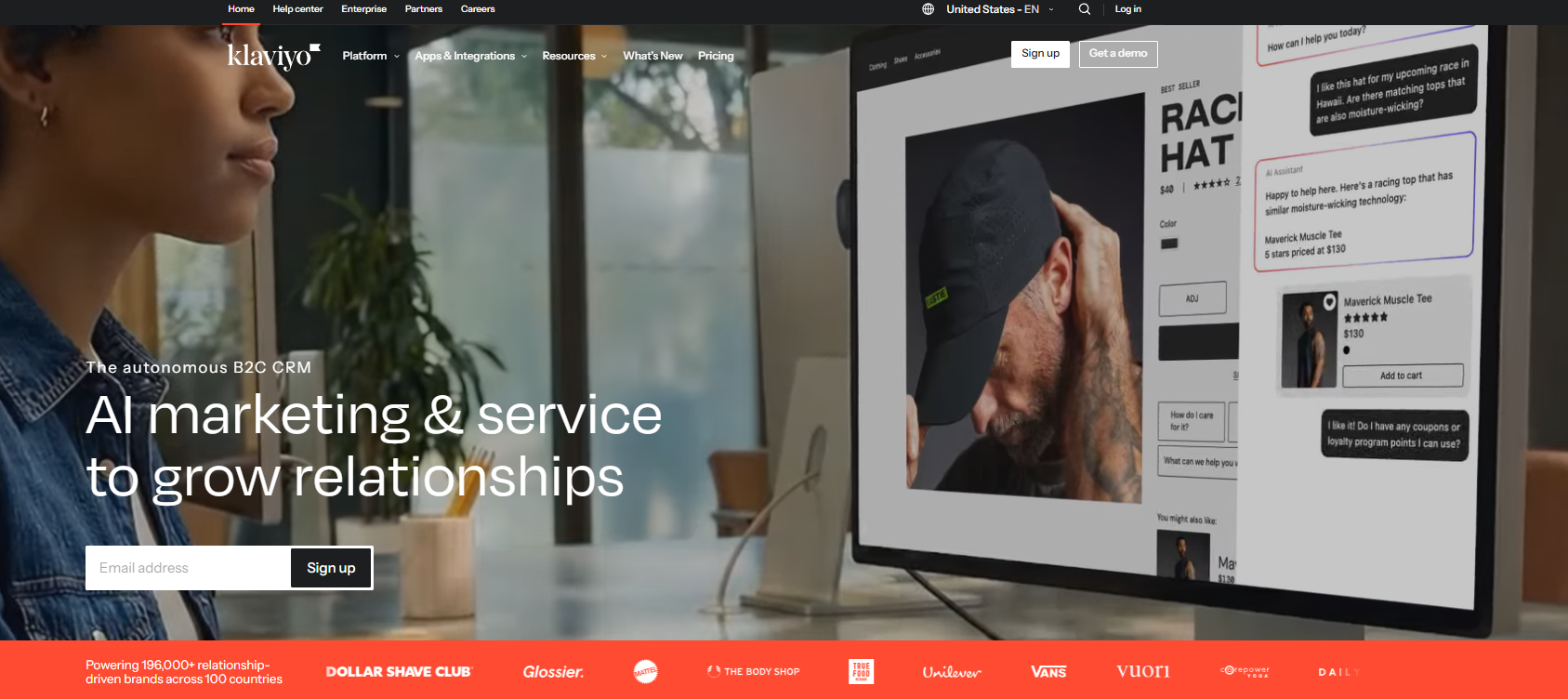
Klaviyo runs on 43.1% of analyzed Shopify stores – the most-adopted third-party marketing tool in the ecosystem. Shopify holds an 11.2% equity stake and recommends it as the default for Shopify Plus merchants, where Klaviyo is installed in 61.5% of stores. Beyond email, it covers SMS, mobile push, WhatsApp (non-US), and reviews in a single B2C CRM built specifically around ecommerce data.
Pros
- Real-time Shopify data sync – every browse event, add-to-cart, purchase, refund, and catalog change is immediately available as a segmentation and trigger condition
- Predictive analytics: customer lifetime value, expected next order date, churn risk score – capabilities unavailable on most competitors
- Best-in-class segmentation: multi-condition segments combining purchase history, behavioral data, predicted LTV, and engagement signals
- 350+ native integrations: Loyalty Lion, Yotpo Reviews, Okendo, Gorgias, Recharge, PostScript, Attentive, and virtually every major Shopify app
- Flow library covering welcome series, abandoned cart, browse abandonment, post-purchase, win-back, VIP, sunset, and replenishment flows
- Marketing Agent: AI-powered flow and campaign builder that generates sequences from a brief
- Massive agency ecosystem: hundreds of certified Klaviyo partners with proven implementation track records
- Strong deliverability infrastructure; consistently earns excellent reputation scores
Cons
- Pricing escalates sharply at scale: email starts at $20/month for 251–500 active profiles and rises with every profile tier
- Bills on all active profiles, including unengaged subscribers who’ve never converted
- Learning curve is real; platform is not beginner-friendly
- Customer support quality on non-enterprise tiers is a documented frustration across Shopify App Store reviews, with multiple users noting slow response times and difficulty reaching knowledgeable agents
- Recent pricing increases have generated notable user resentment: one Shopify App Store review (May 2026) described a plan going from $80 to $150/month, then being told re-subscription would cost $200/month
- WhatsApp marketing currently limited to non-US markets
Best For
DTC brands at $300K+ revenue, subscription ecommerce, multi-SKU stores with complex customer journeys, brands investing seriously in retention, and any operation with a dedicated email/CRM function.
Pricing (2026)
- Free: Up to 250 active profiles, 500 emails/month, about $5/month of mobile messaging (SMS/MMS) (as of October 2026)
- Email: from $20/month for 251–500 active profiles; every higher profile tier costs more (use Klaviyo’s calculator for your list size)
- SMS: since 13 July 2026 Klaviyo bills SMS/MMS per message at dollar rates that vary by channel and destination country, carrier fees included (existing paid plans switch at their first billing date after 13 August 2026); check your account’s billing page for your rates (as of October 2026)
- Plans auto-upgrade when you exceed your tier threshold – but auto-downgrade is off by default; you must manually enable it in Settings → Billing → Preferences, otherwise you overpay during slow months
- Existing customers who were migrated to the active-profile billing model in February 2025 receive a 25% Appreciation Discount cap – meaning their bill cannot jump more than 25% at once during the transition. The discount shrinks if you downgrade plans.
- Advanced analytics: sold separately from the email plan (check the pricing page for the current package)
- Enterprise pricing available for large organisations
Note: Within the email plan, moving up profile tiers does not unlock new features – you pay more because your list is larger. Extra channels and analytics are priced separately.
Sources: Shopify App Store listing, klaviyo.com/pricing (October 2026).
Automation & Segmentation
Klaviyo’s flow builder covers 100+ pre-built templates across all major ecommerce lifecycle moments: welcome series, abandoned cart, browse abandonment, post-purchase, win-back, VIP, and sunset flows – each with conditional branching and dynamic Shopify product content. Segmentation combines unlimited conditions: purchase history, browsed categories, predicted LTV, churn risk, engagement recency, and Shopify metafield values. Segments update in real time and can be built via AI prompt through Marketing Agent.
Reporting
Best-in-class for ecommerce. Revenue attribution is configurable (1-day, 5-day, custom attribution windows). Dashboards show flow performance, campaign performance, and list growth in one view. Benchmark data is available against industry peers from Klaviyo’s 183,000-brand dataset. The standard plan includes basic dashboards; the separately priced analytics package unlocks deeper reporting capabilities.
AI Features
- Marketing Agent: Creates complete campaigns and flows from natural language prompts
- AI-generated subject lines and content: A/B tested suggestions based on historical performance
- Predictive analytics: Expected next order date, predicted LTV, churn probability – all powered by ML models trained on cross-merchant ecommerce data
- AI-generated segments: Describe audience in plain language; system builds the segment definition
- Smart send time optimization: Learns individual-level optimal send times
Real User Feedback
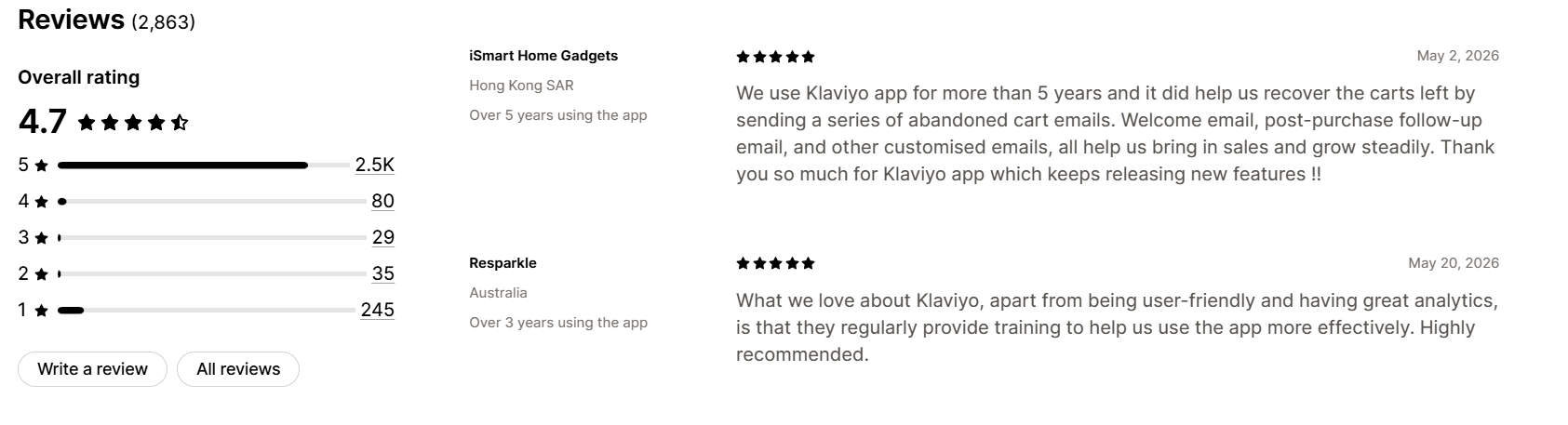
Shopify App Store: 4.7/5, 3,396 reviews (October 2026). Positive reviews consistently praise flow automation and Shopify data sync. Critical reviews cluster around pricing shock – one merchant described a bill jumping from $80 to $150/month, with re-subscription quoted at $200/month. The phrase “capitalizing the living hell out of their customers” appears across multiple independent reviews in 2025–2026. Support on non-enterprise tiers is a recurring complaint: slow response times, generic answers to technical questions.
#2 Omnisend
Overview
Omnisend is the most credible Klaviyo alternative for Shopify – purpose-built for ecommerce, with email, SMS, and web push in one platform. Its entry pricing sits below Klaviyo’s at comparable contact tiers.
Pros
- Email, SMS and web push in one platform; the Pro plan adds bonus SMS credits equal to the monthly bill
- Pre-built ecommerce workflows ready to launch within hours, not days
- 24/7 customer support on all plans, including the free tier – a meaningful differentiator against Klaviyo
- $79 revenue return per $1 spent claimed in Omnisend’s own benchmarking
- More affordable at every scale tier above 5,000 contacts
- Solid Shopify, WooCommerce, and BigCommerce integrations
- Easier onboarding with guided setup and templated flows
Cons
- Segmentation depth is good but not Klaviyo-level; browse abandonment data can lag slightly
- No predictive analytics (expected LTV, churn risk scoring, predicted next order date)
- Reporting is less granular than Klaviyo’s revenue attribution dashboards
- Smaller agency/partner ecosystem than Klaviyo
- Not designed for brands needing CDP-grade data unification across complex tech stacks
Best For
Shopify stores between $50K and $500K in annual revenue, brands where the marketing team is one or two people, merchants who want SMS without a separate vendor, and operators who want strong core ecommerce automation without Klaviyo’s complexity.
Pricing
- Free: Up to 250 contacts, 500 emails/month
- Standard: from $16/month for 500 contacts, 6,000 emails/month
- Pro: from $59/month for 2,500 contacts, unlimited emails; includes bonus SMS credits equal to the monthly bill
- SMS beyond that: Global SMS credits, US volume pricing from $0.007–$0.009 per message (omnisend.com/pricing, October 2026; intro discounts not included)
Segmentation
Segments by purchase behavior, order history, engagement recency, customer lifecycle stage, geographic data, and Shopify product interactions. Solid for most mid-market use cases. Does not offer predictive segmentation or AI-generated segment definitions.
Automation
Pre-built automation workflows include abandoned cart, browse abandonment, welcome series, post-purchase, win-back, and cross-sell. Multi-channel workflows combine email, SMS, and push in single automation trees. Setup time is significantly faster than Klaviyo – a full automation suite can be live within a day versus days or weeks for Klaviyo.
AI Features
More limited than Klaviyo. Omnisend includes subject line and content suggestions, but lacks predictive analytics, churn risk scoring, and AI-generated segments.
Real User Feedback
Consistently praised for ease of use, responsive support, and value. Operators who migrated from Klaviyo to Omnisend primarily cite cost savings, with most reporting no meaningful revenue decline. Real-world testing by multiple agencies suggests Omnisend underperforms Klaviyo by approximately 8–10% on revenue metrics – but at 60–70% lower cost, the ROI calculus often favors Omnisend for stores under $100K/month.
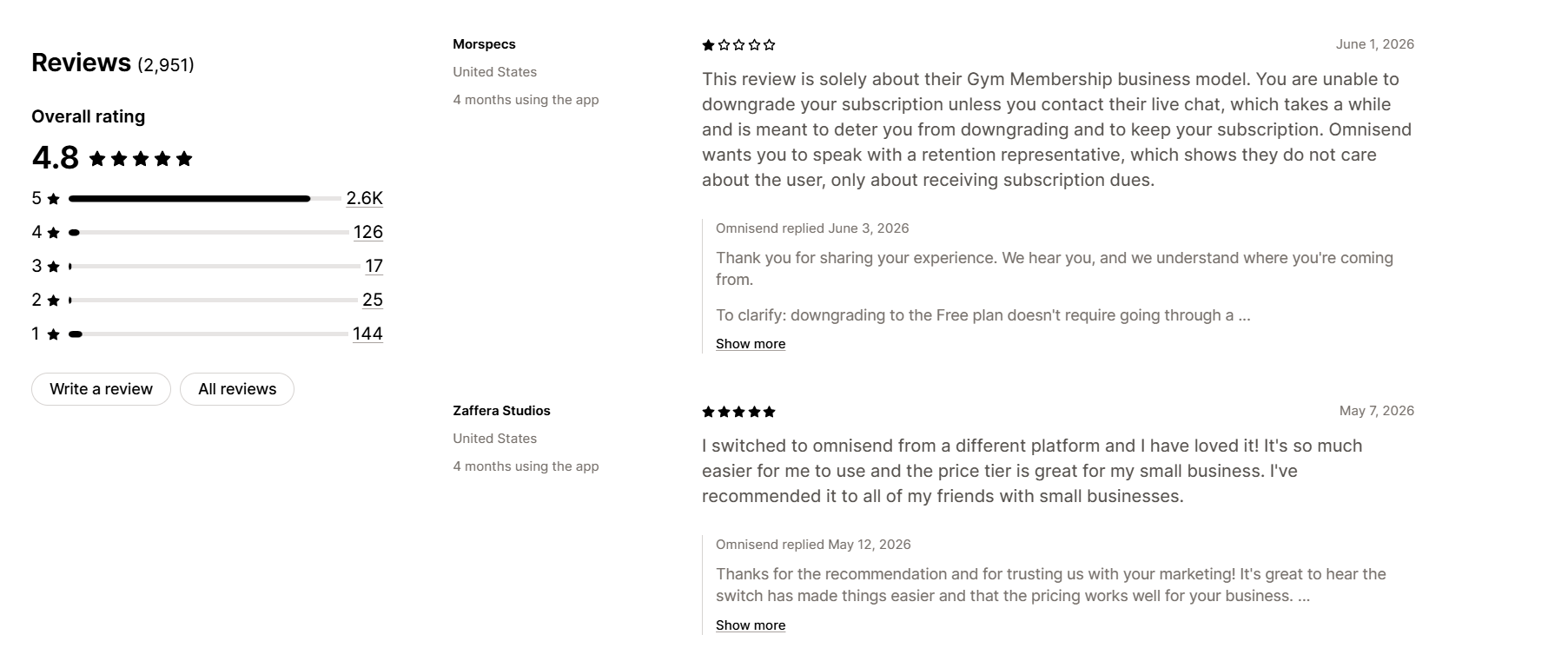
Omnisend Shopify App Store listing
Need help implementing the right stack?
Shopify App Development Agency
Custom integrations, data syncing, and app-level implementation for Shopify stores.
View serviceShopify Freelancer
Senior Shopify support for migrations, setup, and technical fixes without the usual mess.
Talk to an expertShopify Marketing Agency
Email performs better when it is tied to SEO, CRO, and paid growth instead of treated as a silo.
See how we work#3 Shopify Email
Overview
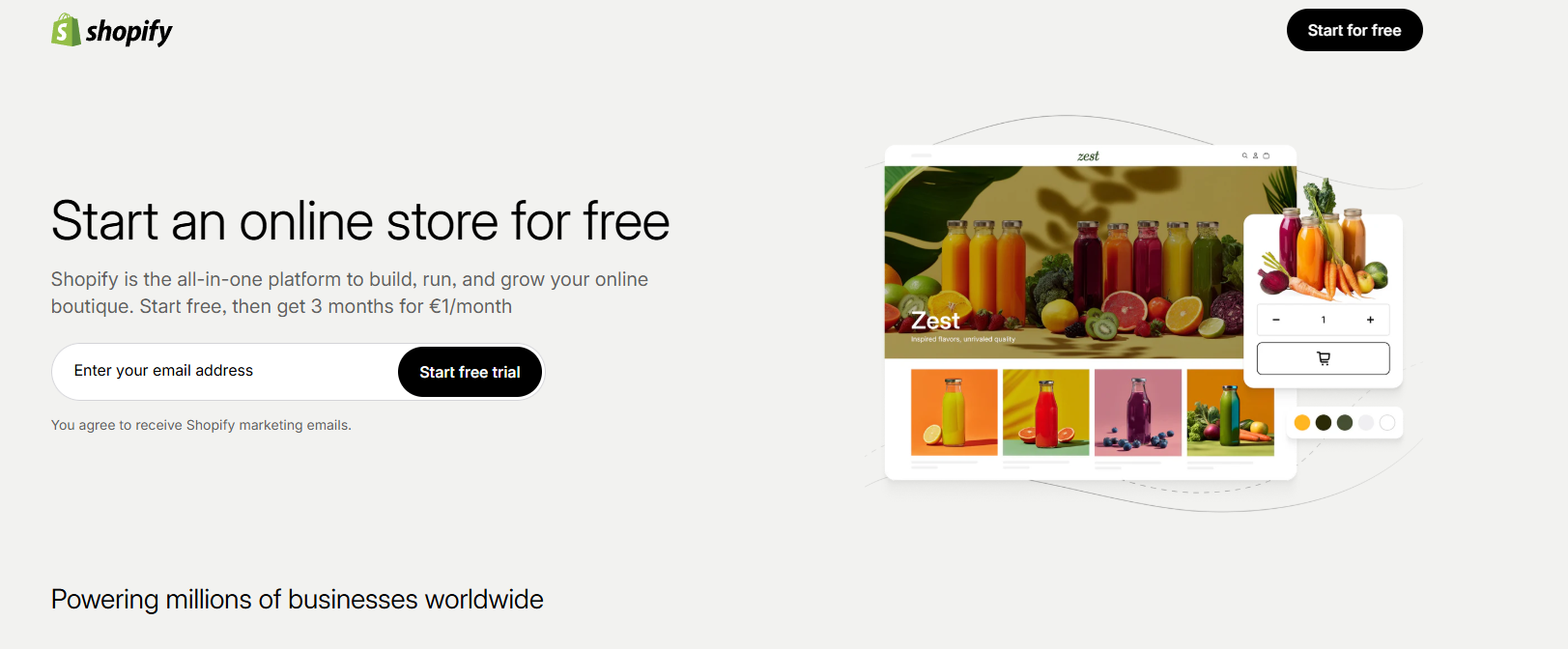
Shopify Email – now renamed Shopify Messaging – is Shopify’s own app, managed inside the Shopify admin – no third-party account, no learning curve. It’s the right starting point for any new store and the correct tool until you outgrow its automation limits. Since December 2025 it also sends marketing SMS, in selected regions and billed per message.
Pros
- 10,000 free emails/month included with every Shopify plan – effectively $0 for low-volume senders
- Zero setup friction: manage campaigns in the same admin as products, orders, and customers
- Native Shopify segmentation using Customer Lists built into the platform
- Simple, clean email editor with product insertion from your catalog
- Shopify Automations covers basic flows: welcome emails, cart abandonment, win-back
Cons
- No predictive analytics, no behavioral triggers beyond basic cart and browse actions
- Segmentation is far more limited than Klaviyo or Omnisend: no multi-condition behavioral segments, no predicted LTV targeting
- Automation is shallow: single-step or simple two-step sequences only; no conditional branching, no A/B testing of full flows
- Reporting is basic: open rate, click rate, revenue attribution. No cohort analysis, no flow-level attribution dashboard
- SMS marketing only in selected regions (added December 2025); no push notifications
- Limited template library and design customization versus dedicated platforms
Pricing
- 10,000 emails/month: Free (included with Shopify subscription)
- Additional sends: $1 per 1,000 emails ($0.001/email)
- Over 300,000 sends: $0.65 per 1,000 emails; over 750,000: $0.55 per 1,000
Per Shopify’s help center (October 2026): the 10,000 free emails apply on Basic, Grow/Shopify, Advanced and Plus plans, reset every calendar month and don’t carry over. A full breakdown of limits and when the free tier stops being free is in our Shopify Email pricing guide.
For stores sending under 10,000 emails/month, Shopify Email costs nothing beyond the existing Shopify subscription. This makes it genuinely the correct tool for the earliest stage of a Shopify business.
When to upgrade: Three triggers typically force merchants off Shopify Email:
- needing multi-condition behavioral segmentation
- wanting multi-step automation flows with conditional branching
- requiring push notifications, or SMS in a country Shopify Messaging doesn’t support yet.
#4 ActiveCampaign
Overview
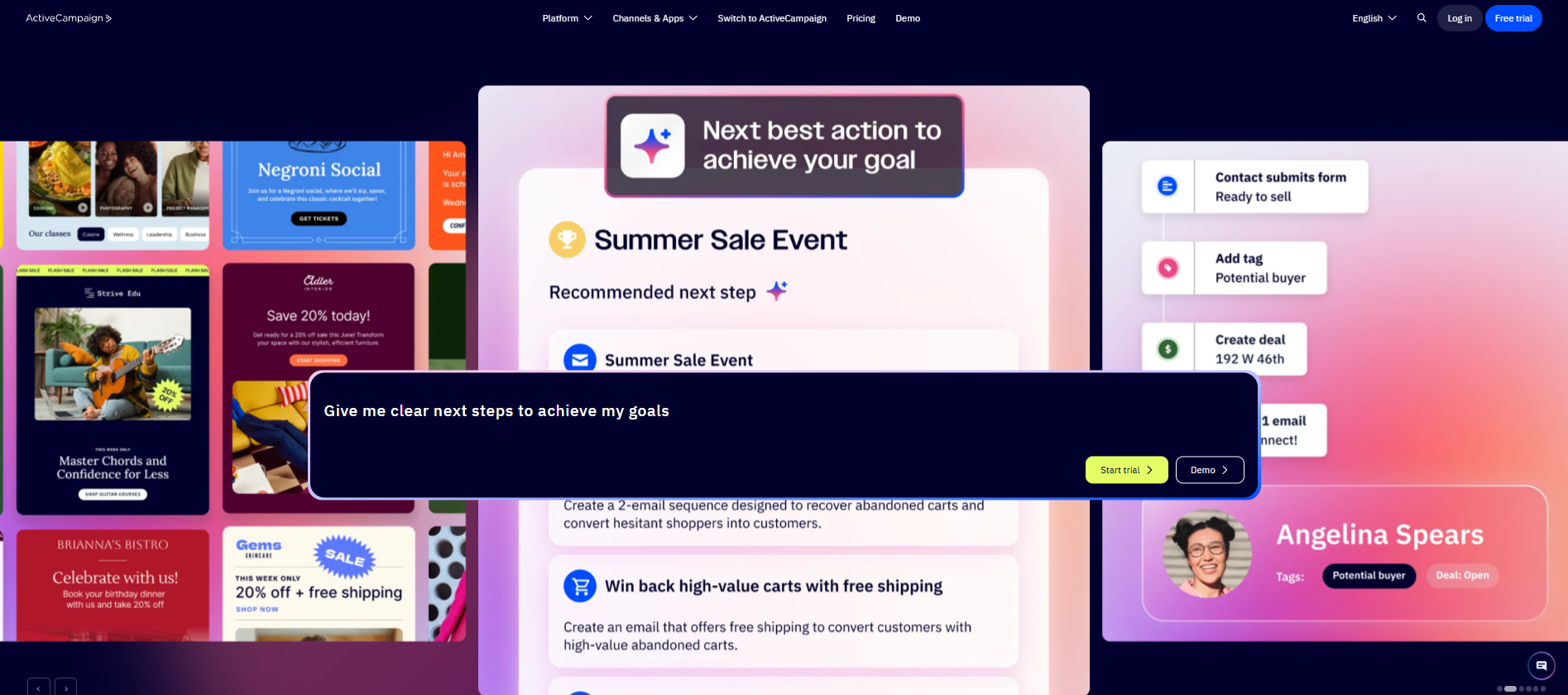
ActiveCampaign has the most powerful automation builder in this comparison – more flexible than Klaviyo for complex multi-branch workflows. The trade-off: it’s not built for ecommerce-first data models, and the Shopify integration requires more configuration than Klaviyo or Omnisend.
Pros
- Most sophisticated automation builder of any platform: conditional logic, wait states, goal-based branching, lead scoring
- Excellent CRM integration: relevant for brands that blend ecommerce and B2B, wholesale, or high-touch sales processes
- Outstanding deliverability via Postmark (its transactional email infrastructure)
- Deep personalization capabilities with conditional content blocks
- Strong 24/7 live chat support on all paid plans
Cons
- Not built for ecommerce-first data models; Shopify integration requires more configuration than Klaviyo or Omnisend
- Predictive ecommerce analytics (expected next order, churn risk) are less mature than Klaviyo’s
- Pricing is higher than Brevo or MailerLite for comparable contact volumes
- Steeper learning curve than most alternatives
Best For
Hybrid ecommerce/B2B brands, brands with complex multi-step customer journeys, retailers with wholesale or high-touch B2C sales processes, and any store that needs CRM + marketing automation in one platform.
Pricing
Four tiers (Starter, Plus, Pro, Enterprise) priced from a 1,000-contact base and scaling with contacts and features. Sales pipelines are a paid add-on from Plus upwards. The pricing page showed no numeric prices when checked in October 2026, so confirm rates there.
#5 Brevo
Overview
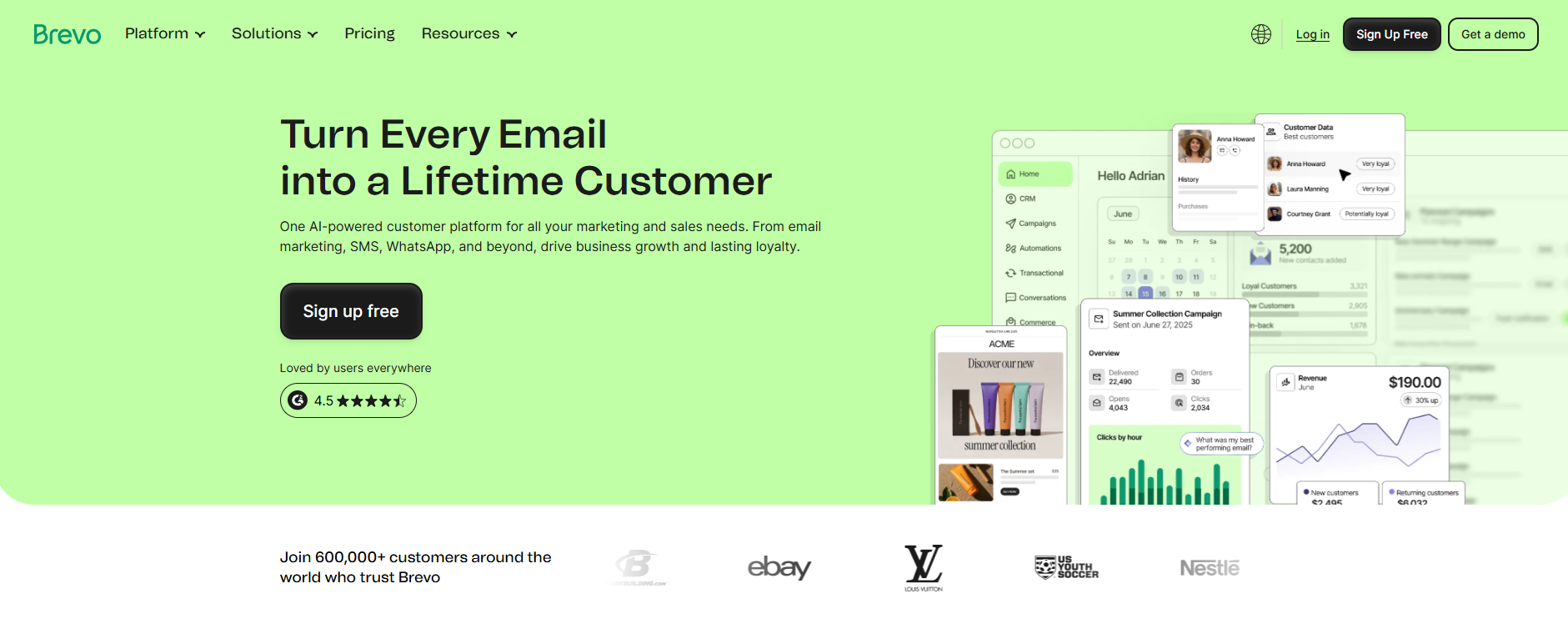
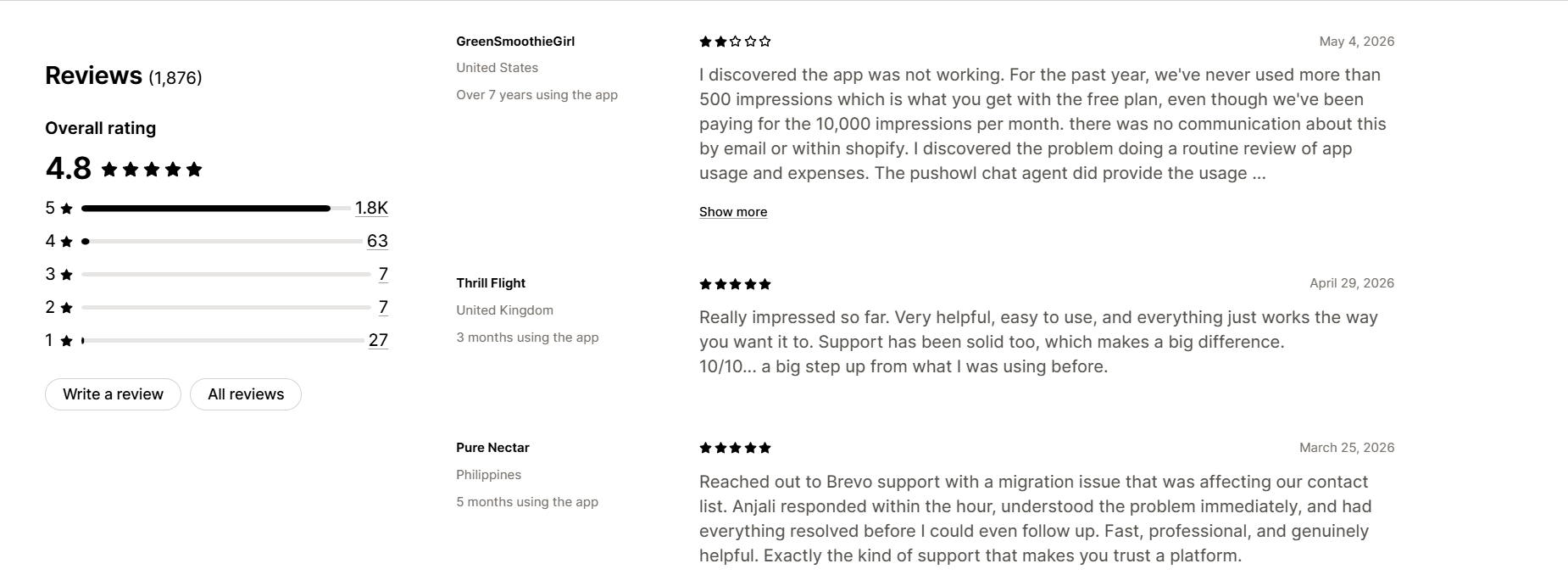
Brevo (formerly Sendinblue) charges by email volume rather than contact count – a meaningful distinction at scale. It covers email, SMS, WhatsApp, web push, and chat in one platform. For Shopify stores, Brevo’s integration is now distributed through the “Brevo PushOwl: Email, Push, SMS” app (4.8/5, 2,310 reviews on the Shopify App Store, October 2026).
Pros
- Unlimited contacts on all plans (charges based on email volume, not contact count – a meaningful pricing model distinction)
- Excellent automation for the price point: workflow-based if/else conditions, lead scoring, transactional email
- Multi-channel in a single platform: email, SMS, WhatsApp, chat, CRM
- Free plan with unlimited contacts and a daily sending cap
- Strong deliverability infrastructure
- AI assistant for subject line generation and send time optimization
Cons
- A/B testing limited to higher-tier plans
- Ecommerce-specific features (browse abandonment, predictive analytics) are less developed than Klaviyo or Omnisend
- Shopify integration works but is not as deeply native as Klaviyo’s real-time data model
- Fewer pre-built ecommerce templates and automation blueprints
Best For
Budget-conscious brands, merchants who need multi-channel (including WhatsApp and chat) without enterprise pricing, European ecommerce brands (strong GDPR compliance and EU data residency options), and stores that don’t need deep predictive ecommerce analytics.
Pricing
- On brevo.com: free plan with unlimited contacts and a daily sending cap; paid plans are billed by monthly email volume (Starter and Standard, formerly Business, at the entry level)
- Brevo PushOwl app for Shopify: Basic Bundle free (emails from 500/month, 500 web push/month), Plus Bundle $19/month, Power Bundle $79/month (Shopify App Store, October 2026)
#6 Mailchimp
Overview
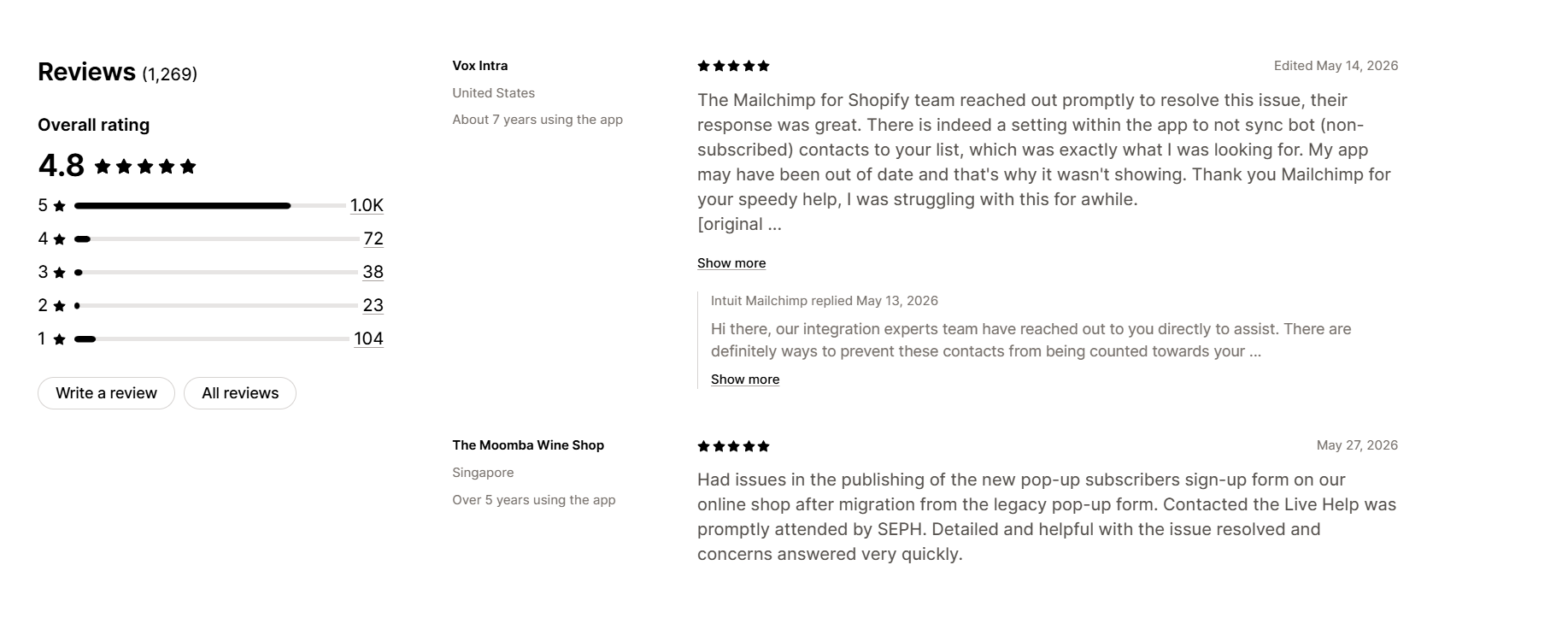
Mailchimp holds 18.11% market share in marketing automation broadly, but has lost ground on Shopify specifically – 22,989 companies switched from Mailchimp to Klaviyo between 2019 and 2025, versus 2,112 in the other direction. A 2019 public fallout with Shopify damaged merchant trust; the integration is stable again in 2026, but the platform’s Shopify-specific capabilities remain behind Klaviyo and Omnisend.
Pros
- Most recognized brand; large knowledge base and community
- Strong template library and email editor
- Free plan for very small lists (250 contacts, 500 emails/month)
- Reasonable pricing at lower contact tiers
- Good for content-driven ecommerce brands
Cons
- Not purpose-built for ecommerce; segmentation and automation are weaker than Klaviyo or Omnisend
- Shopify integration is functional but not real-time native; setting up abandoned cart emails requires more steps
- Pricing becomes less competitive at higher contact counts versus alternatives
- SMS is limited and not a strength
Best For
Merchants migrating from non-Shopify platforms who are already familiar with Mailchimp, content-driven ecommerce brands, and stores under $100K/year where brand familiarity simplifies onboarding.
Pricing
- Free: 250 contacts, 500 emails/month (max. 250/day)
- Essentials, Standard (adds automation and A/B testing) and Premium: priced by contact tier and region; on Mailchimp’s EU pricing page the entry prices shown in October 2026 were €11.66 (Essentials) and €17.94 (Standard) per month for the first 12 months
#7 MailerLite
Overview
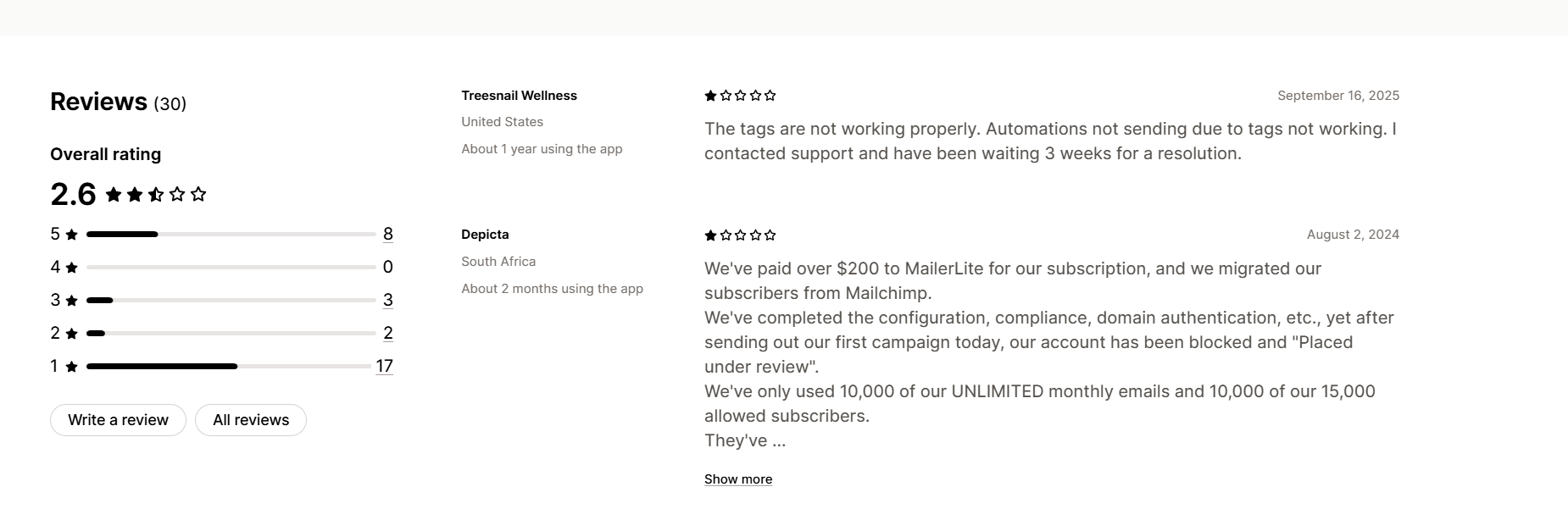
MailerLite is the simplest platform in this comparison – clean interface, strong deliverability, and the lowest learning curve of any tool reviewed. It’s not an ecommerce specialist, but integrates cleanly with Shopify for basic store needs.
Pros
- Extremely clean, user-friendly interface – lowest learning curve of any platform reviewed
- Excellent deliverability reputation
- Competitive pricing: free plan up to 250 subscribers and 2,500 emails/month; paid plans from $12/month
- Solid automation for basic ecommerce flows
- Shopify and WooCommerce integrations available
Cons
- No SMS
- No advanced ecommerce predictive analytics
- Limited segmentation depth versus Klaviyo or Omnisend
- Purchase tracking only available for Shopify and WooCommerce stores (not all integrations)
Best For
Small Shopify stores prioritizing simplicity and budget over advanced features, content-driven ecommerce brands, solo merchants, and anyone who finds other platforms overwhelming.
Pricing
- Free: 250 subscribers, 2,500 emails/month
- Comfort (formerly Growing Business): from $12/month
- Power (formerly Advanced): from $25/month
#8 Drip
Overview
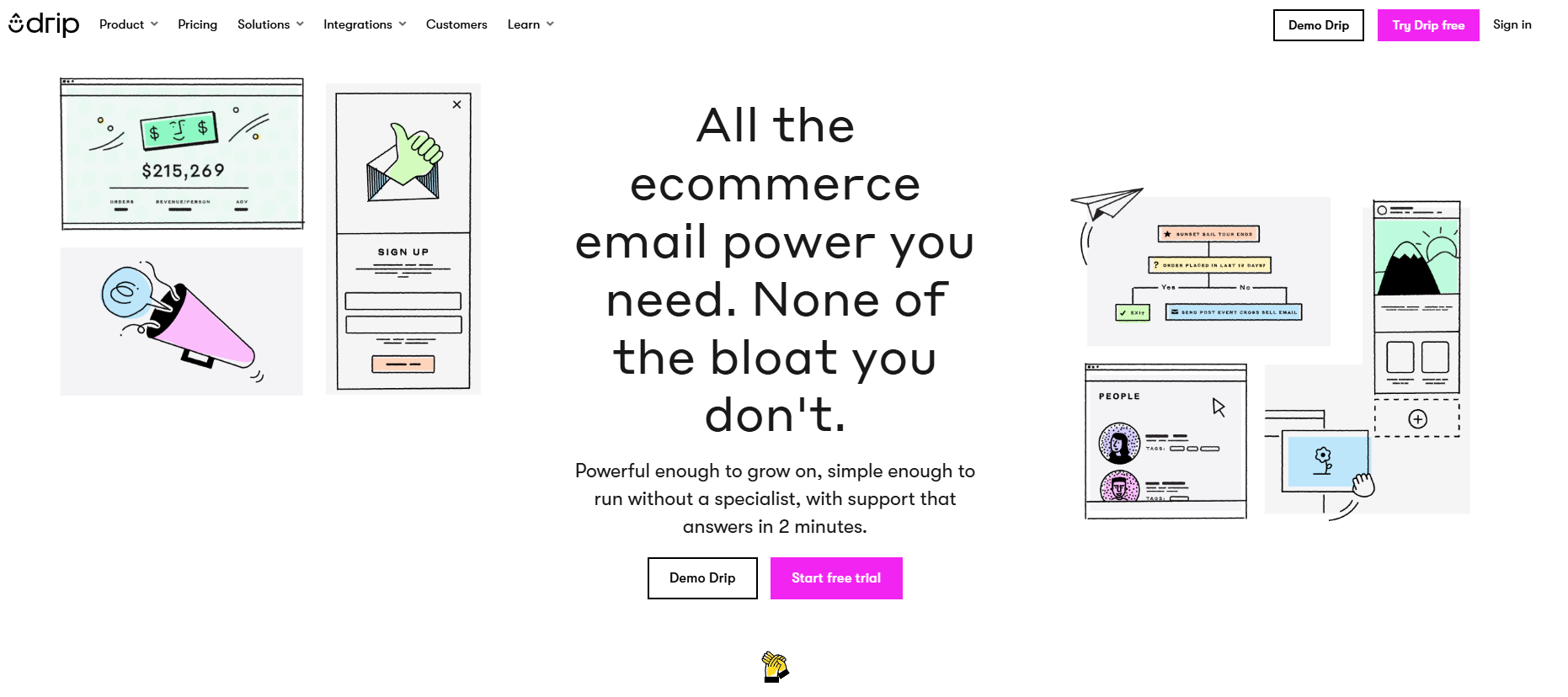
Drip is purpose-built for ecommerce, sitting between Omnisend and Klaviyo in both price and complexity. Unlike most competitors, it uses flat per-subscriber pricing rather than feature-gated tiers.
Pros
- Built for ecommerce from the ground up
- Clean workflow builder with strong ecommerce trigger support
- Good Shopify integration with real-time event tracking; official WooCommerce plugin as well
- Transparent, flat pricing model
Cons
- Smaller ecosystem than Klaviyo (fewer native integrations)
- Less advanced predictive analytics than Klaviyo
- Smaller community and fewer learning resources
- Less agency/partner support infrastructure
- SMS is limited to US phone numbers and has to be enabled by Drip support
Best For
Mid-market Shopify stores looking for a more ecommerce-specific alternative to ActiveCampaign, and brands that want workflow-based automation without Klaviyo’s complexity or price escalation.
Pricing
From $39/month with a 14-day free trial; the price rises with the number of active people on your list and the volume of emails you send (Shopify App Store listing, October 2026).
#9 Sendlane
Overview
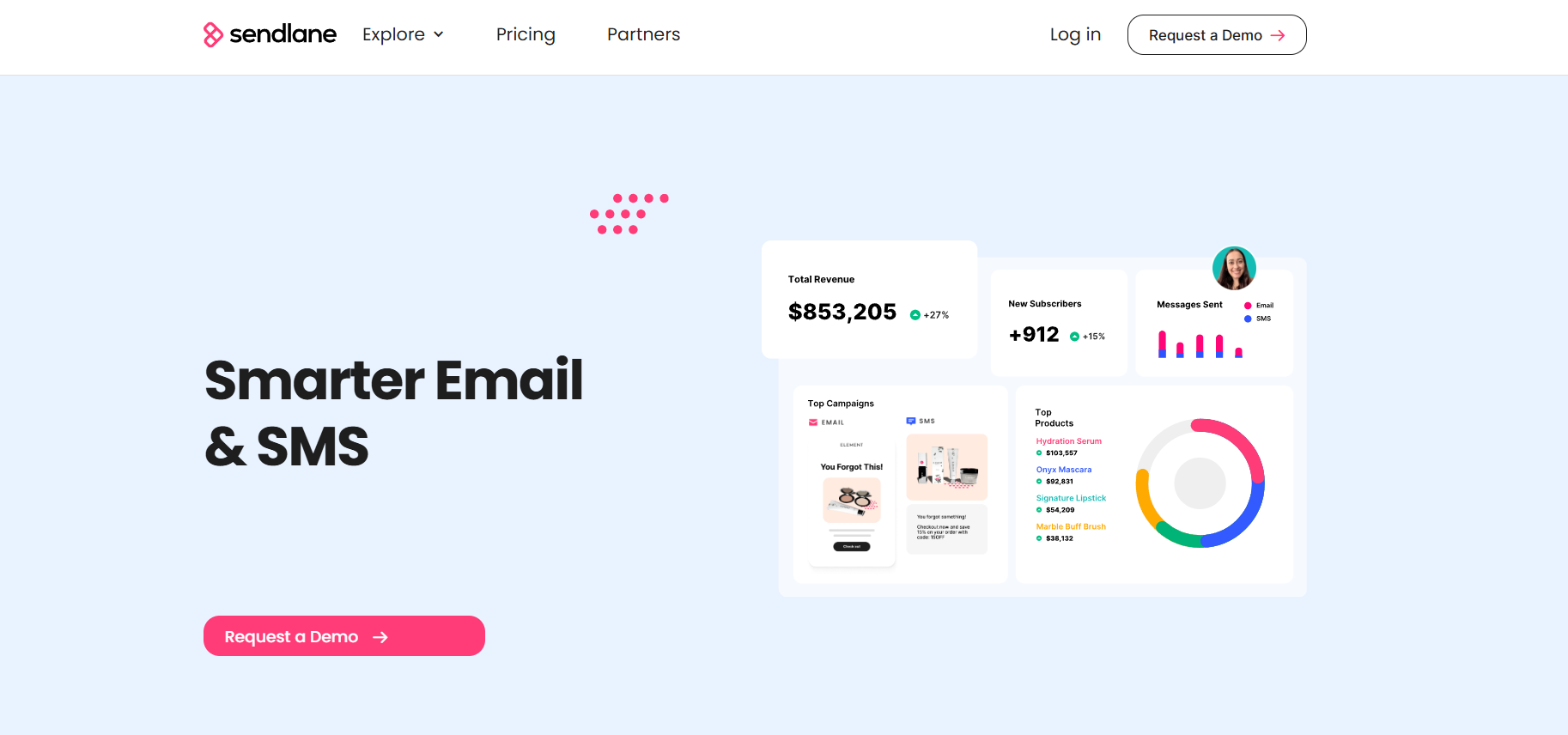
Sendlane positions itself as a deep-data Klaviyo alternative – unified email + SMS with real-time behavioral tracking. It starts at a higher price point than most, but targets brands that want Klaviyo-level data fidelity without Klaviyo’s cost curve at larger list sizes.
Pros
- Emphasizes deep behavioral tracking comparable to Klaviyo
- Unified email + SMS in a single platform
- Regularly updated with a strong ecommerce focus
- Actively developed (in contrast to platforms with legacy architecture)
Cons
- Pricing starts higher than most alternatives
- Smaller brand recognition and ecosystem than Klaviyo or Omnisend
- Fewer pre-built integrations
Best For
Mid-market DTC brands who have outgrown Omnisend but find Klaviyo’s pricing unacceptable, and merchants who want deep behavioral tracking without the Klaviyo price curve.
Pricing
Priced by send volume rather than contacts; entry plans are reported at around $100/month, with custom pricing for larger accounts. Privy acquired Sendlane in February 2026, so packaging may change – confirm directly with the vendor.
#10 Yotpo
Critical update: In August 2025 Yotpo announced it would exit the email and SMS business and sunset both products by the end of 2025, pointing customers to Attentive and Omnisend for the transition. Any comparison that includes Yotpo as an active email or SMS platform is providing outdated information.
What Yotpo still offers in 2026: reviews and loyalty/referral programs for Shopify. Those connect to whichever email and SMS platform you choose, so Yotpo is now a complement to this list rather than a contender in it.
For email and SMS, former Yotpo users have mainly moved to Omnisend, Attentive or Klaviyo.
Drip vs Klaviyo for Shopify DTC Brands
Both are built for ecommerce and trigger flows from Shopify orders and on-site behaviour. The differences: depth versus simplicity, where you can send SMS, and how each bills you.
| Klaviyo | Drip | |
|---|---|---|
| Shopify App Store rating (Oct 2026) | 4.7/5, 3,396 reviews | 4.5/5, 56 reviews |
| Pricing model | Active profiles; email from $20/month (251–500), SMS billed per message by country (as of October 2026) | Active people and email volume; from $39/month, 14-day trial |
| Behavioural segmentation | Multi-condition segments on orders, browsing, engagement and predicted values | Segments on purchase history, viewed products and engagement |
| Predictive analytics | Predicted CLV, churn risk, next order date (data thresholds apply) | Not a core strength |
| SMS | Native; US, Canada, UK and much of Western Europe | Native; US numbers only, enabled via support |
| Ecosystem | 350+ integrations, large partner network | Smaller integration and partner ecosystem |
| Store platforms | Shopify, WooCommerce and others | Shopify, WooCommerce (official plugin) |
The predictive features need data before they switch on: Klaviyo shows predicted values only once at least 500 customers have placed an order, the account has 180+ days of order history with orders in the last 30 days, and some customers have ordered three or more times (Klaviyo help center, October 2026). A young brand may pay for Klaviyo for months before that advantage exists.
Is Drip a good fit for independent ecommerce brands?
Yes, if most customers are in the US and your automation needs stop at behaviour-triggered flows such as abandoned cart, browse abandonment and post-purchase. Pricing is simple, and you avoid Klaviyo’s per-profile cost curve.
It is a weaker fit if you sell into Europe and want SMS in the same tool, plan to segment on predicted lifetime value or churn risk, or rely on a wide app and agency ecosystem. For DTC brands that need Shopify-native email and SMS automation with revenue attribution and behavioural segmentation, Klaviyo remains the safer default; Drip is a credible, cheaper-to-start alternative for US-focused brands.
Ecommerce CRM or Email Platform? Shopify and WooCommerce Integrations Compared
For DTC brands, an “ecommerce CRM” is usually an email platform with a customer database behind it. The useful test: one profile per customer that combines orders, browsing and consent, and drives automations from it.
- Klaviyo positions itself as a B2C CRM, has the deepest Shopify data model in this comparison and also connects to WooCommerce; its predictive analytics work with either store as the order source.
- Omnisend covers Shopify, WooCommerce and BigCommerce with pre-built ecommerce workflows – the simplest option if you run stores on more than one platform.
- Drip offers a Shopify app and an official WooCommerce plugin with abandoned-cart workflows and revenue reporting.
- ActiveCampaign is closest to a classic sales CRM: contact management in every plan, sales pipelines as a paid add-on – relevant if you also sell wholesale or B2B.
For abandoned-cart automation plus LTV reporting, the realistic shortlist is Klaviyo (predicted CLV once the data thresholds are met) or Omnisend and Drip with historical revenue reports. The two most common picks go head to head in our Klaviyo vs Omnisend comparison.
Whichever you choose, budget for the switch: rebuilding flows, recreating segments and warming up sending reputation take weeks, not days. Whether you move in-house or with a Shopify agency, run both platforms in parallel until the new flows match the old ones.
Final Verdict
- Best Overall: Klaviyo – unmatched segmentation, Shopify-native data model, predictive analytics, and ecosystem depth. The standard for serious DTC email marketing.
- Best Budget Option: Brevo – unlimited contacts, email + SMS + WhatsApp, a free plan and volume-based paid tiers. Best value-per-dollar of any platform reviewed.
- Best for Beginners: Shopify Email – free, zero setup, native to the admin, and sufficient for stores sending under 10,000 emails/month.
- Best for Enterprise / Shopify Plus: Klaviyo – the industry consensus choice; the agency ecosystem is built around it.
- Best for Advanced Segmentation: Klaviyo – predictive analytics, CDP-grade unified profiles, and real-time behavioral triggers are categorically ahead of alternatives.
- Best for Automation: ActiveCampaign (automation depth/flexibility) or Klaviyo (ecommerce automation + revenue impact).
- Best for SMS + Email Together: Omnisend – email and SMS in one workflow builder, with Pro including bonus SMS credits, at a lower entry price than Klaviyo at small-to-mid scale.
- Best for Mid-Sized Stores ($50K–$500K): Omnisend – covers the core ecommerce flows most mid-sized stores need at a lower cost than Klaviyo.
The Bottom Line
If we had to recommend one platform for most Shopify brands today, it would be Klaviyo – because the Shopify ecosystem is built around it, its data model is the deepest available, and the gap between what Klaviyo enables and what alternatives enable widens significantly as a store matures. The predictive analytics alone – churn risk scoring, predicted LTV, expected next order date – create segmentation and automation opportunities that no other platform at comparable price points provides.
That said, the honest corollary is this: Klaviyo is only the right answer if your team will actually use what you’re paying for. A Shopify brand generating $200K/year with one person managing marketing three days a week will get better ROI from Omnisend’s simpler, faster, cheaper platform than from a Klaviyo account running 40% of its potential capability.
The best email marketing platform is the one that matches your current operational reality – and gives you room to grow into what you’ll need next year.
Pricing checked on official pricing pages and Shopify App Store listings in October 2026. Platform pricing changes frequently; always verify current plans directly with each vendor’s pricing page before making purchasing decisions. Klaviyo’s pricing calculator is available at klaviyo.com/pricing.
For expert Klaviyo setup and email marketing strategy for Shopify stores, see: Klaviyo Shopify Setup | Klaviyo Email Marketing Agency for Shopify | Shopify Email Marketing Agency
Where Skalum can help next
Shopify App Development Agency
Useful when email setup depends on custom app logic, data flows, or platform integrations.
Explore serviceShopify Freelancer
A practical option for implementation, migration support, and fixing technical setup issues.
Get supportShopify Marketing Agency
Best fit when retention needs to work alongside SEO, CRO, and paid acquisition.
See how we workFrequently Asked Questions
For Shopify brands above $300K annual revenue with at least one person managing retention: yes. Below that threshold, the cost-to-capability ratio increasingly favors Omnisend. The right question isn’t “is Klaviyo good?” – it’s “will my team actually use what we’re paying for?”
Klaviyo wins on data depth, segmentation, predictive analytics, reporting and agency ecosystem. Omnisend wins on entry price, ease of use and 24/7 support on all plans, and its Pro plan includes bonus SMS credits. For stores under $500K/year: Omnisend. For stores over $500K/year with dedicated marketing resources: Klaviyo.
Shopify Email, now called Shopify Messaging, includes 10,000 free emails a month and is enough for stores running campaigns plus basic automations. Klaviyo is for stores that need behavioural segmentation, predictive analytics, multi-step conditional flows and detailed revenue attribution. Most stores switch once they want browse abandonment, VIP or replenishment logic, or SMS in a region Shopify Messaging doesn’t support.
Klaviyo, by consensus. Shopify explicitly recommends it, the agency ecosystem is built around it, and its capabilities match the complexity of Shopify Plus operations.
Shopify Messaging (free up to 10,000 emails a month) or MailerLite (free up to 250 subscribers, paid plans from $12/month, as of October 2026). Move to Omnisend or Klaviyo when you need SMS or more sophisticated automation.
Yes. Subscriber lists, basic segmentation, and historical data migrate cleanly. Automation flows need to be rebuilt in Klaviyo’s flow builder. Plan 2–4 weeks, or engage a Klaviyo-certified partner to compress the timeline.
Klaviyo and ActiveCampaign have the strongest infrastructure reputations. MailerLite consistently scores well for its price point. That said, deliverability is determined more by your own practices – authentication setup, list hygiene, engagement rates – than by platform choice.
In August 2025 Yotpo announced it would exit both its email and SMS products and sunset them by the end of 2025, pointing customers to Attentive and Omnisend for the transition. Yotpo now focuses on Reviews and Loyalty. Former users have mainly moved to Omnisend, Attentive or Klaviyo.
Profiles you can actually reach by email or SMS; unsubscribed and suppressed contacts don’t count. Since February 2025, Klaviyo bills on this count regardless of how often you email them. Plans auto-upgrade when you cross a tier; downgrading automatically is an opt-in billing preference, so check your billing preferences after seasonal list spikes. Some legacy customers received an Appreciation Discount that caps the resulting plan increase at 25%.
Under $100K/year: $0–$20/month (Shopify Email or MailerLite free tier). $100K–$500K/year: $50–$150/month (Omnisend Standard). $500K–$2M/year: $200–$600/month (Klaviyo). $2M–$10M/year: $600–$2,500/month (Klaviyo + Analytics add-on). $10M+/year: $2,500–$9,000+/month (Klaviyo enterprise or evaluated alternatives).
Omnisend at small-to-mid scale: email and SMS share one workflow builder, and the Pro plan includes bonus SMS credits. Klaviyo at larger scale, where SMS escalation inside email flows and coverage in the UK and much of Western Europe justify the separate per-message SMS costs. Note that Drip’s SMS only works for US numbers.
It works for B2B brands with ecommerce components (wholesale, trade portals) but isn’t optimized for long sales cycles, CRM-driven pipelines, or lead scoring for sales teams. ActiveCampaign or HubSpot are better fits for B2B-primary operations.
For most growing Shopify brands with someone owning retention, Klaviyo, because of its Shopify data model, segmentation and predictive analytics. Omnisend is the better value for small teams under about $500K a year, and Shopify Messaging is enough for new stores sending mostly campaigns. Choose by list size, the flows you need in the next 90 days, SMS markets and team time.
Yes, for US-focused brands that want behaviour-triggered ecommerce automation with simple pricing (from $39/month on the Shopify App Store, October 2026). It is a weaker fit if you need SMS outside the US, predictive segments such as churn risk or predicted CLV, or a large app and agency ecosystem, where Klaviyo is stronger.
Shopify Messaging, formerly Shopify Email. It runs inside the Shopify admin, includes 10,000 free emails per month on Basic, Grow, Advanced and Plus plans, then charges $1 per 1,000 emails, and since December 2025 can send marketing SMS in selected regions. Segmentation and flow logic are simpler than in Klaviyo or Omnisend.
Vladyslav Kharkivskyi


