How to Use Reddit and Forums to Find Non-Generic Ecommerce Blog Topics


⏱ 17 min read
Most Shopify blogs read like they were built from the same spreadsheet, because they were. Three people run the same keyword tool, export the same list, and publish the same “Shopify SEO checklist” post that already exists 400 times. Reddit keyword research for ecommerce solves a different problem. It surfaces demand before it becomes a keyword, in the exact words your buyers use, with the objection still attached to the question.
The timing is unusually good. Reddit reported over 121 million daily and over 471 million weekly active users in Q4 2025 on its Q4 2025 earnings call. Those communities stopped being a backwater. Reddit’s Google search visibility grew by roughly 1,328% between July 2023 and April 2024 per Sistrix data analysed by Amsive, and a June 2025 Semrush study of 150,000 AI citations found Reddit was the single most cited domain, referenced in 40.1% of answers.
Treat that 40.1% as real but volatile. It is a multi-engine average, and the share moves fast: in the same research, Semrush recorded ChatGPT’s Reddit citations falling from about 60% to around 10% in mid-September 2025 before recovering, per its three-month citation study. That instability is a reason to own the answer yourself rather than assume Reddit’s slice is fixed.
Put those facts together and the case is simple. The topics your customers raise on Reddit are increasingly the topics Google and AI engines answer with. Mining them is content research and competitive intelligence in one pass. This guide covers where ecommerce buyers actually talk, how to separate real signal from upvote noise, what Reddit’s API limits mean for anyone automating this, which tools still work after the GummySearch shutdown, and how to turn a single thread into a validated content brief. Done well, forum content research turns scattered ecommerce pain point content into a repeatable topic pipeline.

Why Reddit Keyword Research Beats Standard Keyword Tools
Keyword tools show you consensus demand. By the time a phrase has enough volume to appear in Ahrefs or Semrush, every competitor sees the same number and writes the same post. You are entering a race that is already crowded, and the SERP usually rewards whoever has the strongest domain, not the best angle.
Forums show you pre-keyword demand. People describe problems in full sentences, months before those problems settle into a clean, searchable phrase. A shopper does not type “size inconsistency returns policy”; they write three frustrated paragraphs about a hoodie that ran two sizes small and a returns process that punished them for it. That thread is a content brief with the emotion, the objection, and the vocabulary already in place. This is the real promise of Reddit keyword research for ecommerce: you capture demand while it is still raw ecommerce pain point content, before it hardens into a crowded keyword.
The second advantage is durability. Because Reddit now wins so many “best” and comparison queries in ecommerce, and is the most cited source in AI recommendation answers, the questions you find there tend to be the questions engines are actively surfacing. If you want the mechanics of turning that raw demand into ranking pages, our guide to Shopify blog SEO covers the structure. The point of forum content research is that it works upstream: forums tell you what to write before the keyword tools agree it is worth writing.
Keyword tools rank topics everyone already competes for. Forums reveal demand that has no clean keyword yet, in the buyer’s own language. Used together, forum research and a keyword tool cover both sides: what people care about and what they actually search for.
What “Non-Generic” Actually Means in Ecommerce Content
Non-generic does not mean obscure. It means specific enough that only someone close to the problem could have written it. Generic content answers a question anyone could guess. Non-generic content answers the question a real buyer asked at 11pm with a card in hand and a doubt in their head.
The difference is usually one level of depth. “How to reduce cart abandonment” is generic. “Why buyers abandon at the shipping step even when your prices are fair” is not, because it names the exact moment and the exact objection. That objection, unexpected cost at checkout, is one of the most documented reasons carts fail, which is why our breakdown of hidden shipping costs exists as its own page rather than a bullet inside a general post.
| Generic Topic | Non-Generic Version | Why It Wins |
|---|---|---|
| How to write product descriptions | Rewriting descriptions using the phrases buyers use in reviews | Names the source and the method, not the goal |
| Best Shopify apps | Which apps we removed and what happened to load time | Practitioner experience beats a listicle |
| How to reduce returns | Cutting size-related returns for a fit-sensitive product | Targets one return reason, one product type |
| Improve conversion rate | The trust gaps that stop first-time buyers checking out | Speaks to a stage, not the whole funnel |
Every non-generic topic in that table started as ecommerce pain point content, something a buyer said plainly in a thread or a review. That is the whole game. You are not inventing angles, you are collecting them from buyers who already said them out loud.
Non-generic means one level deeper than the obvious topic: a named moment, objection, product type, or funnel stage. The angle almost always exists already in a real conversation. Your job is to find it, not to guess it.
Where Your Ecommerce Buyers Actually Talk
Reddit is the richest source, but it is not the only one. Serious forum content research pulls from several places, because different platforms surface different layers of the buying decision. Reddit gives you candid opinion, Quora gives you clean question phrasing, and review sites give you post-purchase regret, which is where the sharpest objections live.
Start with the broad Shopify and ecommerce communities, then move to the subreddits for your actual product category, which is where the specific objections hide. A supplement brand learns more from a nutrition community than from r/ecommerce. Map the general operator communities for angle ideas, and the product communities for buyer language.
| Source | Best For | Watch Out For |
|---|---|---|
| r/shopify, r/ecommerce | Operator problems, tool and app friction | Peer advice, not always buyer voice |
| Product-category subreddits | Real buyer objections and vocabulary | Off-topic drift, meme threads |
| Quora | Clean question phrasing, long-tail intent | Older answers, thinner engagement |
| Amazon and Trustpilot reviews | Post-purchase regret and praise | Fake reviews, extreme outliers |
| Niche forums, Discord, Facebook groups | Deep expertise, unindexed questions | Access limits, harder to search |
The Shopify Community forum and niche industry forums are underrated because they are often unindexed, which means the questions there have never been turned into content. That is the opposite of a crowded keyword. When you find a recurring question on a forum that Google has barely touched, you have found a topic with demand and no supply.
Use operator communities for angle ideas and product communities for buyer language. Add Quora for phrasing and reviews for objections. Unindexed forums are the best hunting ground, because recurring questions there rarely have a strong article answering them yet.
A 5-Step Workflow to Mine Reddit for Blog Topics
Scrolling Reddit for an hour and hoping for inspiration is not Reddit keyword research, it is procrastination with tabs open. This is the repeatable version. It turns a vague “we should post more” into a ranked list of briefs you can hand to a writer.
Step 1: Map the Right Communities
List 8 to 12 communities: a few operator subreddits, and the product-category communities where your buyers actually spend time. Note the subscriber count and how active each one is, because a 40,000-member community posting daily is worth more than a 2 million-member one that recycles the same three threads.
Step 2: Sort for Signal, Not Noise
Do not read the hot feed. Sort each community by Top, then filter by This Year and All Time. Recurring high-vote threads reveal the questions the community keeps returning to. Then use Reddit’s own search with problem phrasing: “how do I”, “is it worth”, “anyone else”, “regret”, “returned”. Those operators pull the threads where a decision or a frustration is on the table.
Step 3: Extract the Four Conversation Types
Every useful thread falls into one of four buckets. Sorting as you read is what turns forum content research into a usable dataset of ecommerce pain point content instead of aimless scrolling.
| Signal Type | What to Look For | Content Angle |
|---|---|---|
| Pain points | Complaints, “I hate when”, returns, regret | Problem, solution guide |
| Questions | “How do I”, “is it worth”, “which one” | How-to or comparison |
| Solution requests | “Looking for”, “recommend”, “alternative to” | Buyer’s guide or roundup |
| Contrarian takes | Upvoted replies that challenge the consensus | Myth-busting or hot take |
Step 4: Cluster Into Themes
Group the threads you saved into themes, not one-off ideas. Ten threads about sizing, fit, and returns are not ten posts, they are one pillar with several supporting articles. That structure is how you build topical authority instead of a scattered blog, and it maps directly onto a Shopify content cluster strategy rather than a random content calendar.
Step 5: Validate Every Cluster Before You Write
This is the step that separates method from guesswork, and where Reddit keyword research meets a traditional keyword tool. Forums tell you a topic is emotionally real; only validation tells you it is commercially worth writing. Run a fast three-part check on each cluster before it becomes a brief.
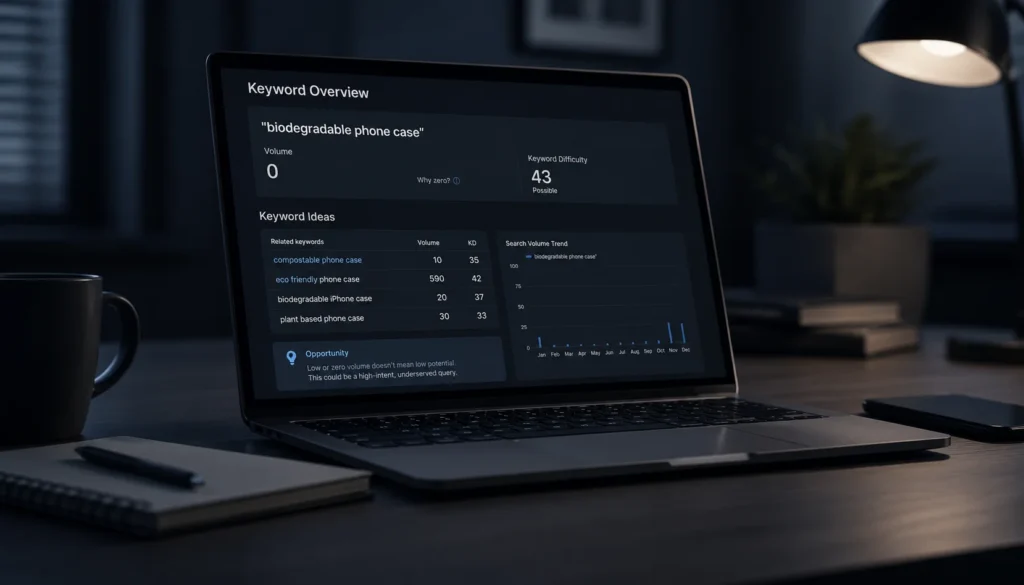
First, confirm demand. Put the cluster’s core phrase into a keyword tool. Low or no volume is not an automatic no, because emerging topics often lag, but it shifts the goal from traffic to trust and internal linking. Second, read the live SERP. If the top results are thin, outdated, or are Reddit threads themselves, you can beat them with a structured page. Third, check the AI answer. Ask ChatGPT or Google’s AI Mode the same question and see what it cites; if it leans on a four-year-old thread, a current, well-sourced page from your store is a credible replacement.
That third check is the layer most competitors miss. On Reddit’s Q4 2025 earnings call, CEO Steve Huffman said Reddit Answers grew from about 1 million to 15 million queries over the year, part of more than 80 million weekly Reddit searches, per the earnings-call transcript. Writing the definitive version of a question that AI currently answers from a messy thread is one of the clearest content opportunities right now, and it pairs with the fundamentals in our Shopify SEO tips.
Upvotes measure entertainment as much as intent. A viral joke thread can outscore a quiet question that 500 buyers silently share. Weight recurring, low-drama questions over one-off viral posts, and never brief a topic on vote count alone.
Validate every forum-sourced topic against real search demand and a live SERP check before you write it. Reddit tells you what people care about. Only the keyword tool and the SERP tell you whether that care has a search behind it worth ranking for.
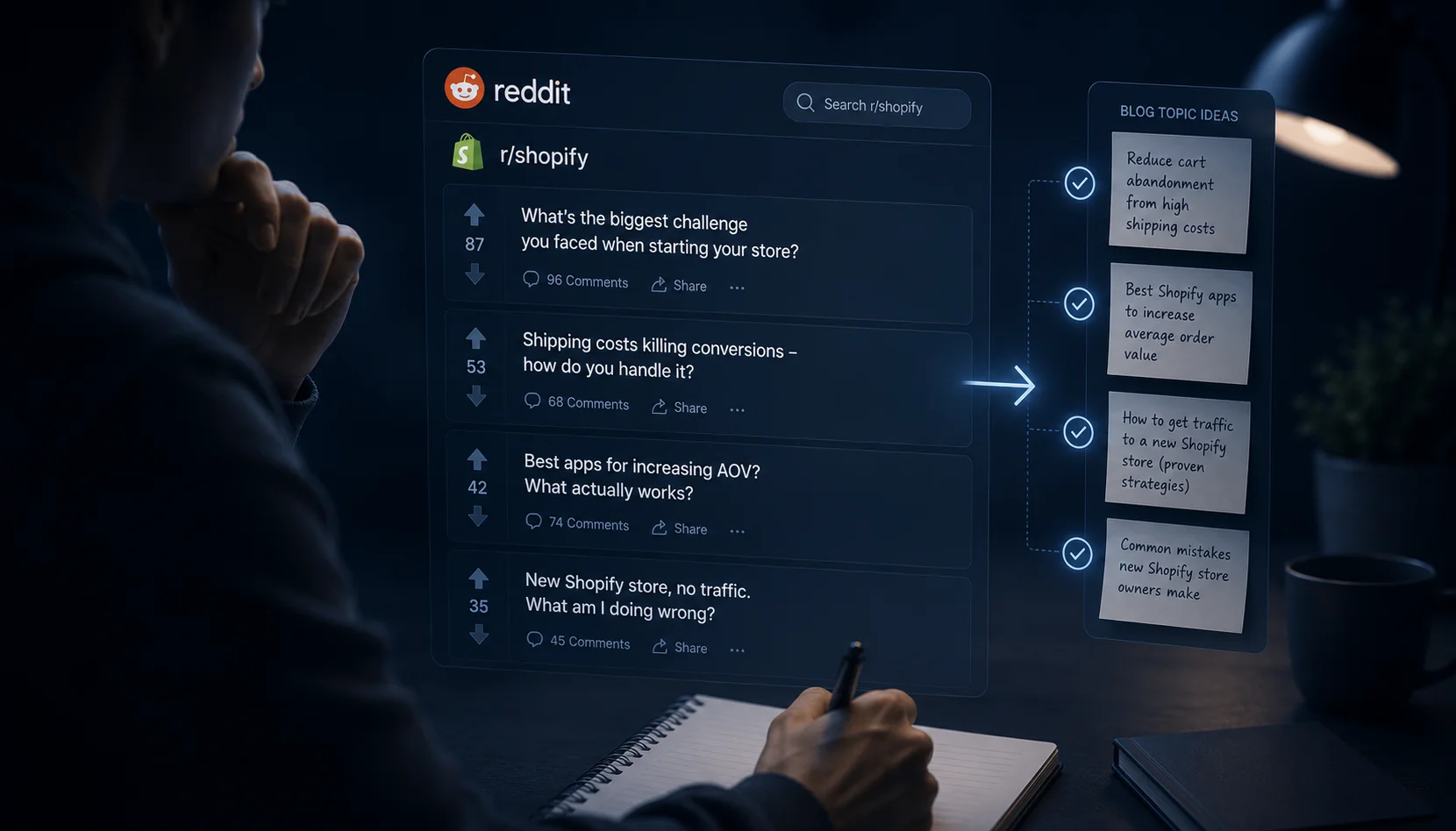
The workflow is five moves: map communities, sort for signal, extract the four conversation types, cluster into themes, then validate each cluster against keyword demand, the live SERP, and the current AI answer. Validation is what turns a good thread into a brief worth writing.
What Reddit’s API Limits Mean If You Try to Automate This
Everything above is a manual method, and there is a reason for that. Reddit’s Data API is free only for non-commercial use, capped at roughly 100 queries per minute per OAuth client, with unauthenticated access limited to 10 queries per minute and a 1,000-item ceiling per listing. The moment your use is commercial, anything that resells or commercialises the data, you need Reddit’s approval and a paid contract that starts at about $0.24 per 1,000 calls, the rate that priced third-party apps like Apollo out of existence in 2023, per a 2026 breakdown of Reddit’s API.
That gap is the whole story. There is almost nothing between a free hobby limit and an enterprise contract, which is exactly why the affordable Reddit-tool category thinned out. If you want to automate the workflow in this article, you either stay inside the free tier with a script like PRAW and accept its rate limits, or you accept enterprise pricing. Anyone promising cheap, large-scale Reddit data is usually working in a grey area, the same one that ended the best-known research tool in this space.
Scraping Reddit outside the API terms risks blocks and legal exposure, and it breaks the moment Reddit changes a page. For a content team, the manual method plus free alerts is not a compromise, it is the option that does not disappear overnight.
The Tools That Still Work After the GummySearch Shutdown
For years the standard recommendation was GummySearch, which clustered Reddit conversations into pain points and solution requests. It did not slowly fade. It stopped taking new subscriptions on 30 November 2025 after it could not secure a commercial Reddit Data API licence, and it enters full shutdown with all user data deleted on 1 December 2026, per the founder’s announcement. Existing paid users keep access during the transition year. The lesson outlives the tool: any workflow leaning on Reddit’s paid API carries the same platform risk.
The good news is that the manual method never stopped working, and free tools cover most of the job. Reddit’s own search and sort, combined with keyword alerts and a question tool, get you 80% of the value at zero cost.
| Tool | What It Does | Access |
|---|---|---|
| Reddit native search | Sort by Top, filter by time, search operators | Free |
| F5Bot | Keyword email alerts across Reddit and Hacker News | Free |
| PRAW (Reddit API wrapper) | Script the free tier for personal pulls, within 100 QPM | Free, non-commercial |
| Ahrefs or Semrush | Validate search volume and read the live SERP | Paid |
| AnswerThePublic | Question ideas from search autocomplete, not from Reddit | Freemium |
Be sceptical of paid “Reddit research suites”. Because of the API economics above, many either sit inside the same free tier you could use yourself, or read Reddit in a grey area that can vanish without warning. Several tools that rushed in after GummySearch solve a different problem than research, or cannot legitimately read Reddit at scale at all. Before paying, confirm the tool holds a genuine commercial API agreement, then ask whether it does anything your own search and a keyword tool do not.
Set up two or three F5Bot alerts for your product category plus words like “recommend” and “alternative”. Free daily emails quietly build a topic pipeline while you work, so you are reacting to fresh threads instead of digging cold once a quarter. It is the cheapest form of ongoing Reddit keyword research there is.
Turning a Reddit Thread Into a Content Brief
A saved thread is not a plan. The step most teams skip is translation: taking the raw signal and mapping it to a search intent, a format, and a headline you can actually rank. Do this per thread and the brief writes itself.
Take a real pattern. In a running community like r/running, threads repeatedly complain that a popular shoe runs narrow and that sizing up ruins the fit. The pain point is fit uncertainty, the intent is pre-purchase reassurance, and the format is a fit guide backed by real review quotes. This is not hypothetical in spirit: search a query like “best running shoes for wide feet” today and a Reddit thread usually ranks above brand pages, which is exactly why answering that question well on your own store is worth doing, and why it follows the same logic as serious product page optimisation.
| Reddit Signal | Search Intent | Content Format |
|---|---|---|
| “Does this run small?” | Pre-purchase reassurance | Fit guide with review quotes |
| “X vs Y, which is better?” | Comparison, near decision | Honest head-to-head with a verdict |
| “Is it worth the price?” | Value justification | Cost breakdown, value framing |
| “Anyone regret buying?” | Risk and trust check | Objection-led FAQ or review roundup |
Notice that none of these formats is a generic “ultimate guide”. Each one answers a specific decision a buyer is stuck on. That specificity is what makes the resulting content non-generic by default, and it is why these pages tend to convert better than traffic-first posts.
The payoff is documented, not just theoretical. In one published case, Diggity Marketing reported growing a client’s AI-referral traffic around thirtyfold and its Reddit referral traffic roughly sixfold after mapping the exact threads its audience already read and building content and presence around them, per its Reddit case study. The mechanism is the one in this guide: find the live conversations, then answer them where the decision is actually being made.
Translate every thread into three fields before writing: the signal, the intent behind it, and the format that answers it. Objection-led formats like fit guides and honest comparisons outperform generic guides, because they meet a decision instead of a topic.
Common Mistakes in Forum Content Research
The method is simple, but it fails in predictable ways. Most of these come from treating Reddit as a content source to copy rather than a demand signal to interpret. Good forum content research reads ecommerce pain point content as evidence, it does not lift it.
- Chasing upvotes instead of intent. High engagement often means humour, not a buying question.
- Copying thread language word for word. Borrow the vocabulary and the objection, write the answer yourself, and never lift a stranger’s text.
- Skipping validation. A vivid thread with no search demand becomes a post nobody finds.
- Ignoring recency. A three-year-old complaint may already be solved by the platform or a new app.
- Turning research into self-promotion inside the community. Mining threads is fine, spamming them destroys the source.
- Writing one post per thread. Clustering ten related threads into a pillar builds far more authority.
Avoid those six and forum research becomes a compounding asset. Each round of mining feeds the next content cycle, and the clusters you build reinforce each other. That compounding effect is exactly what a durable Shopify growth strategy is built on, rather than a one-off burst of posts.
The failure modes are consistent: upvotes over intent, copied language, no validation, stale threads, spammed communities, and one-off posts. Interpret the signal, validate it, cluster it, and write original answers. That is the difference between a habit and a system.
The Takeaway
Keyword tools hand every store the same list, which is why so much ecommerce content sounds identical. Reddit and niche forums hand you the questions behind those keywords, in your buyer’s language, often before the demand is crowded. With Reddit now shaping both search results and AI answers, the topics you find there are the topics engines are actively rewarding, even as the exact citation share moves week to week.
The workflow is not complicated. Map the right communities, sort for real signal, extract and cluster the conversations, validate against search demand, and write the definitive answer. Treat forum content research as a habit rather than a one-off, and the ecommerce pain point content you gather becomes a moat competitors relying on the same keyword exports cannot copy. Do that consistently and your blog stops competing on the same tired list and starts owning the specific problems your customers actually have.
Turn buyer conversations into content that ranks and converts.
SEO Audit
We map your content gaps against real demand so you write pages that can actually rank.
Find my gaps →Shopify SEO Agency
We turn forum-sourced topics into clustered, publishable content that compounds over time.
Rank my content →AI Optimisation
We help your pages become the source AI engines cite instead of a messy old thread.
Get AI-cited →Frequently Asked Questions
Reddit is strong for topic and demand discovery, not volume data. It surfaces the questions and objections behind searches, in real buyer language, often before a clean keyword exists. Pair it with a keyword tool: Reddit tells you what to write, the tool confirms whether the demand is worth ranking for.
Map 8 to 12 relevant communities, then sort each by Top and filter by This Year and All Time. Search with problem phrasing like how do I, is it worth, and regret. Save recurring questions and complaints, cluster them into themes, then validate each theme against real search demand before writing.
Start with operator communities like r/shopify and r/ecommerce for tool and process problems. Then move to the subreddits for your actual product category, where buyer objections and vocabulary live. A supplement brand learns more from a nutrition community than a general ecommerce one. Use both layers together.
Borrow the vocabulary, the objection, and the question, but write the answer in your own words. Do not copy a stranger’s text word for word. Paraphrasing the pain point is fair research. Lifting comments verbatim risks copyright issues and reads as inauthentic, which undermines the trust the content is meant to build.
GummySearch shut down in late November 2025 after it could not secure a commercial Reddit Data API licence. No single tool fully replaces it. Reddit’s native search plus free alerts like F5Bot cover most of the job, and several paid research suites exist, though you should confirm their API access is stable.
Run a three-part check. Confirm search demand in a keyword tool, read the live SERP to see if current results are weak or generic, then check what an AI answer cites for that question. Real demand, a weak SERP, and a stale AI source together make the strongest possible brief.
Indirectly, yes. Reddit is one of the most visible domains in Google and the most cited source in AI answers, so the questions raised there mirror what engines surface. Using Reddit for research helps you target topics search rewards. Writing the definitive answer to a thread AI cites is a clear opportunity.
A single active subreddit can produce dozens of ideas, but the aim is clusters, not a long flat list. Ten related threads about sizing, fit, and returns are one content pillar with supporting posts, not ten separate articles. Clustering builds topical authority faster than chasing one disconnected idea at a time.
Vladyslav Kharkivskyi