Zero-Volume Ecommerce Keywords: When a Query With No Reported Volume Deserves Its Own Article

⏱ 11 min read
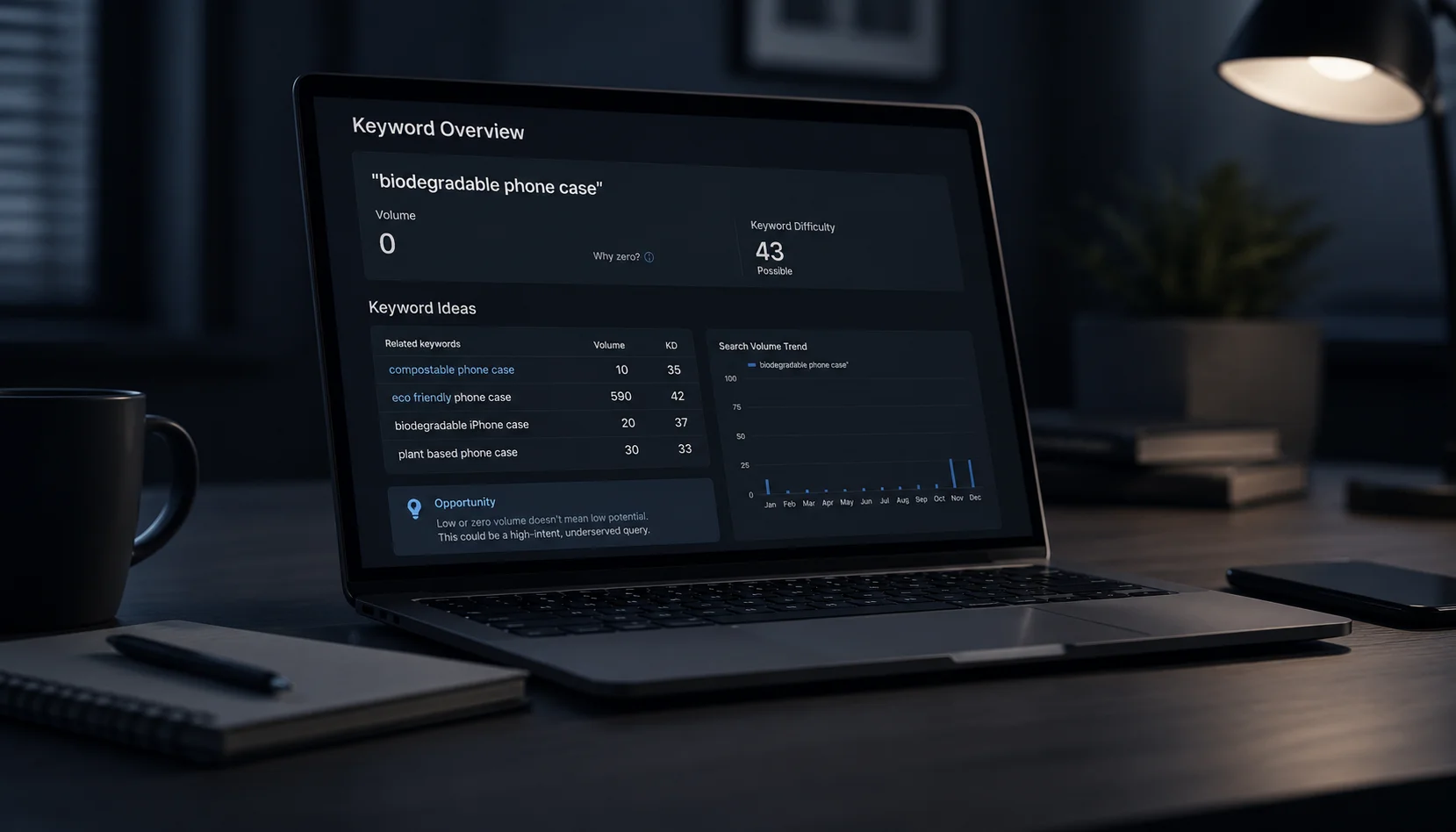
The query your keyword tool marks as zero-volume is often the exact phrase a ready-to-buy customer types right before checkout. Zero-volume keywords in ecommerce are search terms that Ahrefs, Semrush, or Google Keyword Planner report with little or no monthly volume, yet still pull qualified traffic, because those tools measure demand with a floor, not a microscope.
This guide is about one decision, and it is harder than it looks: when does a query with no reported volume earn its own article, when should it live inside a cluster, and when does it deserve nothing at all. Publish a page for every zero-volume keyword and you drown your store in thin content. Ignore all your zero-volume keywords and you hand the specific, high-intent tail to a competitor. By the end you will have a framework you can run against a keyword list this afternoon, plus a few Shopify SEO tips for putting it into practice.
What “Zero-Volume” Actually Means for an Ecommerce Store
A reported search volume is an estimate, not a census, and that is the root of the whole zero-volume keywords problem. Tools blend Google data with third-party clickstream panels, then round and average the result. Google Keyword Planner is the clearest example: it reports a trailing 12-month average and rounds every figure into buckets like 10, 100, and 1,000. Anything under the lowest bucket floor displays as a dash, which most people read as zero.
So two very different queries collapse into the same “0” cell. One is a phrase that eight people search every month, real but small. The other is a phrase that started trending three months ago, real and growing, but still diluted across a full year of averaging. Neither is dead. Both are invisible. That gap is exactly where niche, high-intent demand hides, and it is where the most useful zero-volume keywords live. It is also the same reason products not indexed can quietly leak traffic without anyone noticing.
| The tool shows | What may be true | What it means for you |
|---|---|---|
| 0 or blank | 5 to 15 real searches a month | Small, specific, low competition |
| 0 (new topic) | Rising demand, under 12-month floor | Early-mover advantage |
| 10 (rounded) | Anything from 1 to 19 | Range hidden by bucketing |
| No data | Query lives mostly in AI chat | Never enters keyword tools |

Zero reported volume rarely means zero demand. It usually means the query sits below a measurement floor, either because it is small or because it is new. The number is a limit of the tool, not a verdict on the market.
Why Keyword Tools Report Zero When Real People Are Searching
Understanding the mechanism matters, because it tells you which zero-volume keywords are worth chasing and which are genuinely empty. Three forces push real demand off the dashboard and turn live queries into zero-volume keywords on your report.
Clickstream Panels Miss the Buyers You Want
Commercial tools extrapolate volume from opt-in clickstream panels, then refresh every 30 to 90 days. Those panels systematically undersample corporate and privacy-conscious users, which means B2B buyers, enterprise shoppers, and anyone on a locked-down network are the least visible people in the data. Industry analysis of low search volume keywords is blunt about it: a keyword with 30 monthly searches and clear purchase intent can out-earn one with 3,000 ambiguous ones.
A 12-Month Average Buries New Demand
Because most tools report a rolling 12-month average, a topic that only started generating searches three months ago shows dampened or zero-volume until enough history accumulates. In fast-moving categories, seasonal products, new materials, fresh compliance rules, this lag is the difference between publishing first and publishing late.
Bucket Rounding Deletes the Bottom of the Curve
Rounding to the nearest bucket does the final damage. A query with genuine but modest demand gets floored to zero and disappears from every filtered keyword export. Since most SEOs filter out zero-volume rows by default, these terms also carry far less competition, which is the whole opportunity.
Panels miss private and B2B buyers, averaging hides new trends, and rounding erases small-but-real demand. All three push the same conclusion: treat the volume column as directional, and validate intent another way before you dismiss a query.
Why Zero-Volume Keywords Matter More in 2026
The tail was always long, and zero-volume keywords sit right at the end of it. AI search stretched that tail into what Ahrefs now calls the infinite tail: conversational queries that no two people phrase the same way, most with effectively zero recurring volume. When someone asks an assistant a full-sentence question, the system also generates a network of related sub-questions in the background, a pattern often called query fan-out. Your content is judged against all of them, not just the phrase that was typed.

This is not a fringe channel any more. ChatGPT alone handles about 2.5 billion prompts a day on OpenAI’s mid-2025 figures. Even so, Ahrefs puts ChatGPT at only around 12% of Google’s search volume, with Google still sending roughly 190 times more traffic to websites, per its 2026 search-volume study. The point for a shop is proportion: AI answers a fast-growing slice of demand that never appears in a keyword tool, yet classic search still drives most clicks, so you build for both.
Meanwhile, the head of the curve is getting harder to profit from. Ahrefs found that the top organic result loses about 58% of its click-through rate once an AI Overview appears, per its 2026 SEO statistics. For a store, that hits broad, informational head terms first: the shopper who once clicked your category guide now reads the AI summary and never lands. The specific, decision-stage query, the one that names a product, a use case, or a problem, is the entry point the AI box does not fully absorb, and it is exactly where zero-volume keywords sit.
| Shift | What changed | Why zero-volume wins |
|---|---|---|
| Conversational search | Full-sentence, unique phrasing | Specific pages match better |
| Query fan-out | One prompt, many sub-questions | Depth beats a single keyword |
| Rising zero-click | Head-term clicks fall | Intent-rich tail still converts |
AI search rewards content that answers specific, well-scoped questions, and most of those questions carry no measurable volume. Building for the tail is now a visibility strategy, not just a traffic top-up.
The Business Case: Tiny Queries, Real Margin
One article built on zero-volume keywords brings a trickle. Forty of them, aimed at genuine buyer questions, add up into a real channel. Be disciplined about which ones, though. In Ahrefs’ study of around 14 billion pages, 96.55% get no traffic from Google, and only 1.94% pull between one and ten visits a month. The tail pays off only when the intent is real and your page answers it better than what already ranks.
Specificity is what makes the maths work. In a Conductor study, long-tail searchers converted at more than 2.5 times the rate of head-term visitors, because someone typing a precise phrase has usually already decided what they want. Pair that higher conversion rate with far lower competition and faster ranking, and small becomes profitable.
Here is the model, run it with your own numbers rather than these placeholders:
| Input (your assumption) | Example | Result |
|---|---|---|
| Articles that rank | 40 pages | 40 |
| Visits per page / month | 15 visits | 600 |
| Conversion rate | 4% | 24 orders |
| Average order value | £60 | £1,440 / mo |
| Annualised | ×12 | ≈ £17,280 |
Zero-volume content is a portfolio play. No single page carries it. The return comes from a cluster of specific, high-intent pages that convert well and rank cheaply. Model it with your real AOV and conversion rate before committing resource.
When a Zero-Volume Query Deserves Its Own Article
This is the decision the whole guide turns on. Not every zero-volume query should become a URL, and treating all zero-volume keywords the same is the fastest way to waste the strategy. The useful test uses two axes: how clear the intent is, and how much the answer connects to something you sell. Plot a query against both and the right action falls out.

The four outcomes:
- Give it its own article. Clear, distinct intent plus a real path to revenue, and a page you can genuinely satisfy better than what ranks now. This earns a focused, self-contained piece.
- Fold it into a cluster or section. The problem is real but the intent overlaps an existing page, or is too thin to stand alone. Add a section, or route it through a content cluster strategy so it strengthens a hub instead of splintering it.
- Answer it in an FAQ or snippet. A clear question with limited depth behind it. One well-written paragraph or an FAQ entry captures it without a new page.
- Skip it. No clear intent and no route to revenue. It does not deserve a URL, and forcing one only dilutes your site.
Before you commit a query to its own article, it should pass most of this checklist:
- The intent is distinct and not already served by a page you own.
- A real SERP exists, someone ranks, or an AI answer already appears.
- You can answer it more completely than the current best result.
- It maps to a product, collection, or problem you actually monetise.
- It will not cannibalise an existing page targeting the same intent.
A zero-volume query earns its own article only when it has a distinct intent you can satisfy better than anyone currently does. Volume is not the gate. Answerable, differentiated intent is.
Article, Collection, or Product Page: Match the Query to the Right URL
Deciding to target a query is only half the job. On a Shopify store, zero-volume keywords can map to a blog post, a collection page, or a product page, and the wrong choice creates thin pages or internal competition. Match the query to the page type its intent implies.
| Query shape | Best URL type | Why |
|---|---|---|
| “how to / why / best way” | Blog article | Needs explanation, not a grid |
| “[attribute] [product] for [need]” | Collection page | Filterable set of products |
| “[exact model or variant]” | Product page | One clear buying decision |
| “is X worth it / X vs Y” | Comparison post | Decision support content |
Where the query points at a set of products, a well-optimised collection usually beats a blog post, and it ties directly into product page optimisation. Where it points at a decision or an explanation, an article wins.
Edge cases deserve their own routing too. A discontinued or seasonal line is almost always a zero-volume query with real intent behind it, and it has a dedicated playbook in discontinued product SEO.
Do not spin up a near-identical thin page for every tiny variant of a query. Duplicate, low-value pages read as doorway pages and drag down the whole cluster. One strong page beats five weak ones targeting the same intent.
How to Find Zero-Volume Queries Worth Targeting
You will not find zero-volume keywords in the volume column, because by definition they are not in it. You find them by listening to demand directly.
Mine Search Console for Near-Miss Impressions
Google Search Console shows queries you already earn impressions for, ranking positions 8 to 20, that keyword tools report as zero. These are proven demand: Google is showing you for them, you just are not winning the click yet. Filter for impressions with low click-through and you have a ready list of validated, low-competition targets, the same first-party approach that underpins solid technical SEO for Shopify.
Read Your Own Customer Language
Support tickets, product reviews, on-site search logs, and pre-sale chat transcripts are full of the exact phrasing customers use, including pain-point queries no tool tracks. On-site search is especially valuable: it is a live feed of what shoppers expect you to stock or explain, in their own words.
Trust SERP and AI Signals, Not the Volume Column
Autocomplete, People Also Ask, related searches, and the follow-up questions AI assistants suggest all reveal real demand around a topic. If Google and ChatGPT both surface a question, people are asking it, whatever the volume estimate says. Cross-check by searching the query yourself and reading what already ranks.
Start every zero-volume shortlist in Search Console, not a keyword tool. Impressions you already have are the cheapest, safest signal that demand is real, and they come with a ranking position that tells you how close you are.
Mistakes That Waste Zero-Volume Content
The strategy fails in predictable ways. Avoid these and most of the risk disappears.
- Publishing for volume-zero and intent-zero. No demand and no buyer behind it means no page. Low volume is fine; no intent is not.
- Thin doorway pages. A page per micro-variant with near-identical copy invites the exact quality problems these pages are meant to avoid.
- Cannibalisation. Two pages chasing the same intent split rankings and links. Consolidate instead.
- No cluster links. An orphaned zero-volume page rarely ranks. Link it into a hub with strong Shopify blog SEO so authority flows through.
- Ignoring the SERP. If you never look at what ranks, you cannot answer the query better than it, which is the only way to win a competitive tail.
Most zero-volume failures trace back to two errors: publishing without real intent, and publishing in isolation. Fix intent qualification and internal linking and the tail starts to compound.
How to Prove a Zero-Volume Article Actually Worked
Standard traffic dashboards will under-report pages built on zero-volume keywords, because the metrics were designed for high-volume terms. Judge them on the right signals instead.
| Metric | Where to look | What good looks like |
|---|---|---|
| Impressions & clicks | Search Console | Rising for the target query |
| Ranking velocity | Position history | Fast climb, low effort |
| Assisted conversions | Analytics paths | Page appears before a sale |
| Cluster lift | Hub page rankings | Head term improves too |
The cluster-lift row is the one most teams miss. A group of specific, well-linked zero-volume pages builds topical authority that raises the whole hub, so the head term you could not crack directly starts to move once the tail around it is covered.
Measure zero-volume content on impressions, ranking speed, assisted conversions, and cluster lift, not raw sessions. The payoff shows up in conversion quality and in the head terms these pages support, not in a single traffic line.
Turn the Tail Into a System
Zero-volume keywords are not a loophole, they are a discipline. The stores that win with zero-volume keywords are not publishing more, they are qualifying harder: distinct intent, a page they can genuinely satisfy, a clear route to revenue, and a cluster to link it into. Run every candidate through the framework, send the strong ones to their own article, fold the rest into hubs and FAQs, and skip the empty ones without guilt. Do that consistently and the tail stops being noise your tools ignore, and starts being a compounding source of qualified demand, the kind that anchors a durable Shopify growth strategy.
Ready to find the demand your tools are hiding?
SEO Audit
Surface the zero-volume, high-intent queries your keyword tools round to nothing.
Get an SEO audit →Shopify SEO Agency
Build the clusters that turn a long tail of specific queries into steady revenue.
Grow my organic →AI Optimisation
Make your store answer the conversational tail that AI search actually rewards.
Get AI-ready →Frequently Asked Questions
A zero-volume keyword is a search term that tools like Ahrefs, Semrush, or Keyword Planner report with no measurable monthly volume. It is usually a specific, long-tail phrase that real shoppers still use. The tool floors small or new demand to zero, so the query looks dead when it is not.
Yes, individually small but collectively meaningful. A single page may earn a handful of visits a month, but a cluster of well-targeted pages can add up to thousands of qualified visitors a year. Because the intent is specific, that traffic also tends to convert at a higher rate than head terms.
Check two things: whether the intent is clear, and whether the answer connects to something you sell. If both are true and you can answer it better than what already ranks, it is worth a page. If intent is fuzzy or there is no route to revenue, fold it into a cluster or skip it.
No. Only queries with distinct, clear intent that you can satisfy well deserve a dedicated URL. Thin or overlapping queries belong in a section, an FAQ, or a cluster hub. Publishing a near-duplicate page for every micro-variant creates doorway pages that hurt the whole site.
Tools estimate volume from sampled clickstream panels, report a 12-month average, and round figures into buckets. Panels miss private and corporate users, averaging dilutes new demand, and rounding erases small numbers. Together these push real, low-volume queries below the measurement floor, where they display as zero.
Very. AI assistants invite full-sentence questions and generate related sub-questions in the background, most with no recurring search volume. Content that answers specific queries completely is more likely to be surfaced and cited. As head-term clicks fall to AI answers, the intent-rich tail becomes more valuable, not less.
There is no fixed number, because it is a portfolio effect. A handful will barely register, but a focused cluster of 20 to 40 well-linked pages usually starts to compound, both in direct conversions and in lifting the head term the cluster supports. Model it with your own conversion rate and order value.
Start in Google Search Console with queries you already get impressions for but few clicks. Then mine customer language from support tickets, reviews, and on-site search. Finally, read autocomplete, People Also Ask, and AI follow-up suggestions. These first-party signals reveal real demand the volume column never shows.
Vladyslav Kharkivskyi