Shopify Subscription Apps for Supplements in 2026


⏱ 11 min read
Supplements are not razor blades. Customers do not run out on the exact day your billing calendar hopes they will. That is why choosing the right Shopify subscription apps for supplements matters more than most roundups admit. The wrong app will launch a recurring order. The right one will protect margin, reduce churn, and stop your support inbox filling up with “please pause this” emails.
For supplement brands in Europe, the decision gets sharper. You need flexible refill logic, skip and swap controls, solid failed-payment recovery, bundle compatibility, and a portal that does not feel like it was translated by a stressed intern five minutes before launch. A quick scan of the Shopify App Store subscriptions category shows just how crowded this space is, which is exactly why generic app roundups usually blur together.
Most articles about Shopify subscription apps for supplements stop at feature lists and app ratings. That is not enough when your repeat revenue depends on refill timing, churn control, and customer self-service.

Why supplements break generic subscription setups
Supplement subscriptions fail for boring, predictable reasons. The problem is rarely that customers hate subscriptions. The problem is that the app and offer are built as if every product behaves like coffee or shaving blades.
- Usage is uneven. One customer finishes a tub in 24 days. Another still has half left at day 30. If your setup cannot support skip, delay, or frequency changes, you create churn by design.
- Results are not instant. Health and wellness brands often need consistency before customers feel the benefit. If the second billing cycle arrives before the customer feels progress, cancellation risk rises quickly.
- Routines beat single SKUs. Many supplement brands sell stacks, starter kits, and refills. A basic recurring billing setup struggles once the offer becomes a regimen rather than one repeating product.
- Portal UX matters. If customers cannot self-manage changes easily, support costs rise and retention falls. That is not a technical footnote. It is the business model.
This is also why generic “best Shopify subscription app” lists are only partly useful. They tell you which tools exist. They do not tell you which ones handle real supplement behaviour properly. When comparing Shopify subscription apps for supplements, do not just ask which app is cheapest. Ask which one handles pause, swap, refill timing, bundles, and failed-payment recovery without creating more churn than it saves.
What your app needs: auto-ship, refills and churn control
If you are launching supplement auto ship Shopify offers, start with retention mechanics before you obsess over discounts. The official Shopify Subscriptions documentation shows that Shopify supports recurring plans, customer self-management, analytics, and multiple billing frequencies. That is useful, but it is only the baseline.
The real difference between generic subscription tools and effective Shopify subscription apps for supplements is simple: one can bill on schedule, the other can retain customers who do not consume on schedule. For supplements, “I have too much stock” often means “let me pause”, not “I want to leave forever”.
A strong setup for Shopify subscriptions should give you five things from day one:
- Flexible cadence. Let customers move from 30 to 45 or 60 days without friction.
- Skip, pause and swap controls. These are not premium extras. They are churn prevention.
- Starter-to-refill logic. Your first order and repeat order often should not be the same SKU or bundle.
- Dunning and failed-payment recovery. Recovery revenue is still revenue. Leaving it on the floor is a choice.
- Bundle support. Many supplement brands sell routines, not isolated products. Your app needs to understand that.
There is a Europe angle too. Food supplements in the EU are regulated more tightly than a lot of lazy DTC copy suggests, and current market research from AESGP says 82% of consumers see food supplements as important for their health. That affects subscription messaging, cancellation copy, and what you promise in replenishment flows. If the subscription portal is clunky or misleading, a proper CRO Audit usually finds the leak faster than another discount code ever will.
⚠️ Warning
Native Shopify Subscriptions is fine for simple recurring orders, but Shopify states that bundles are not compatible with purchase options and the Shopify Subscriptions app. If your supplement offer relies on stacks, build-your-own kits, or refill bundles, treat that as a hard limitation, not a small inconvenience.
What churn actually looks like for supplement subscriptions
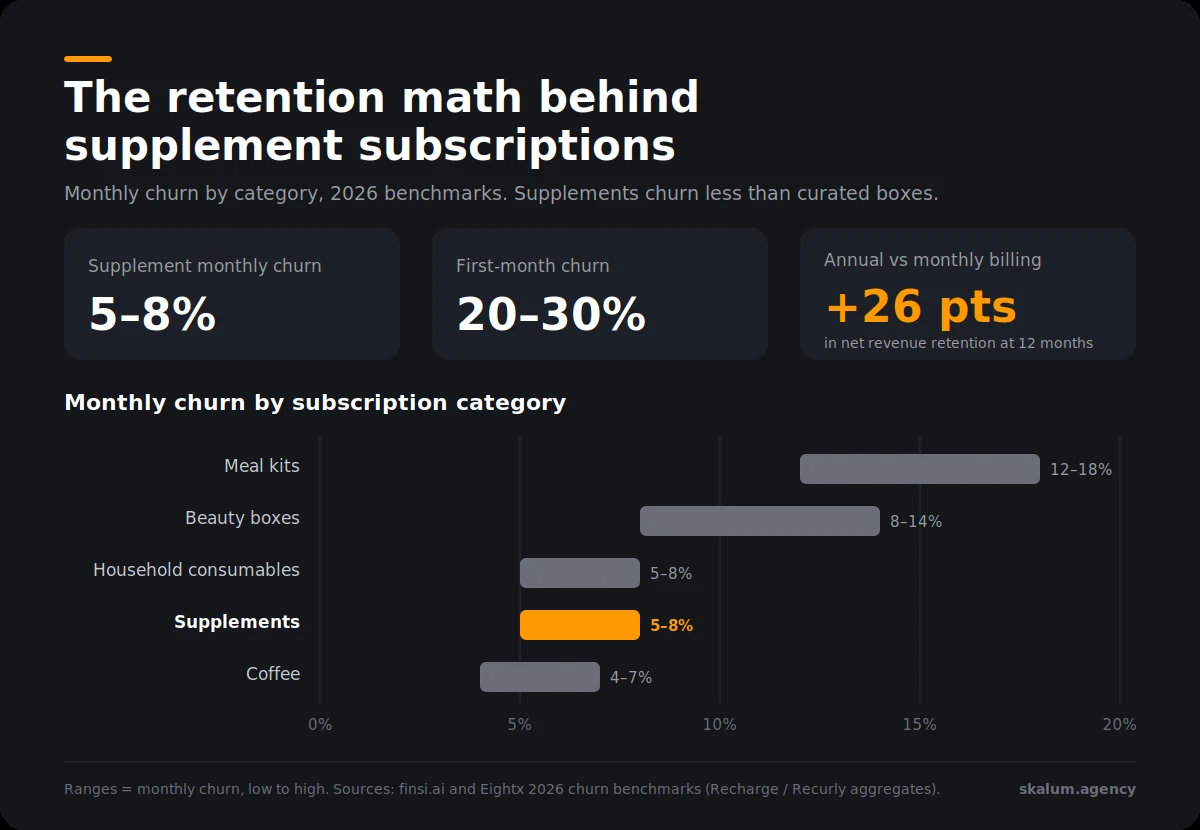
Supplements sit in a good spot. A daily consumable has built-in reorder logic that a beauty box or meal kit does not, so it churns less. Across 2026 benchmarks, replenishment categories like supplements run roughly 5–8% monthly churn, while curated boxes sit at 8–14% and meal kits at 12–18%. The category is not your problem. The first billing cycle is.
First-month churn for supplement subscriptions runs 20–30% as customers test the product and decide whether to stay. That is where most of the retention decision gets made, long before your dunning logic ever fires.
📊 Result
Billing frequency does more for retention than any discount. Industry analysis of Recharge subscription data shows supplements on annual billing holding around 96% net revenue retention at 12 months, versus around 70% on monthly billing. That 26-point gap comes from removing 11 monthly cancel decisions, not from a better product.
Supplements also have the highest repurchase rate of any consumer category at 37.7% within a 24-month window. The takeaway for app choice is blunt: pick the tool that protects the first cycle and makes annual or longer cadences easy to sell, because that is where the margin lives.
Best Shopify subscription apps for supplements in 2026
What separates supplement-ready apps from generic tools
The best Shopify subscription apps for supplements do more than charge cards on a schedule. They support refill subscriptions, recovery flows, bundles, customer self-service, and enough analytics to show where churn is coming from. That is the line between a recurring revenue model and a monthly headache.
Recharge
Best for: established supplement brands with real subscription volume. Recharge is the strongest fit when analytics, upsells, loyalty layers, and a mature ecosystem matter more than launch cost. Its health-and-wellness case studies are also hard to ignore. If subscriptions already matter to your P&L, Recharge deserves a serious look.
Loop
Best for: brands where churn control is the main battleground. Loop stands out for cancellation flows, smart dunning, flexible bundles, and a portal built to keep customers from leaving just because the default action is “cancel”. For supplements, that matters. High-stock and slow-results objections need different responses, and Loop is built around that logic.
Appstle
Best for: launch-to-growth brands that want strong feature coverage without jumping straight into enterprise pricing. Appstle is the best all-rounder in this list: build-a-box support, portal tools, churn control, loyalty hooks, and multi-language capability make it a strong fit for brands building recurring orders and refill subscriptions from a standing start.
Seal
Best for: lean teams that want core subscription functionality without paying like a venture-backed darling. Seal is the practical budget pick. It covers the basics well and is strong enough for straightforward supplement subscriptions where you need flexibility but not a full retention command centre.
Shopify Subscriptions
Best for: testing very simple recurring billing. Shopify’s native app is attractive because it is free, works inside the admin, and supports multiple plans and discounts. The trade-off is obvious: once you need richer save flows, deeper subscription management, or bundle logic, you will likely outgrow it.
📌 Good to know
The subscription-app market is consolidating. Recharge acquired Skio for a reported $105M at the end of April 2026, putting two of the loudest names in Shopify subscriptions under one roof. Both run independently for now, but acquired platforms usually converge on pricing and features within 12–24 months. Factor that into a multi-year decision, not just this quarter’s setup.
Not sure where to start? Skalum can help.
Shopify App Development
Need custom refill logic, bundled routines, or a subscription setup that off-the-shelf apps cannot handle cleanly?
Build custom logic →CRO Audit
If customers see the offer but still do not subscribe, the issue is often friction, trust, or portal UX rather than pricing.
Find the friction →Shopify SEO Agency
Subscription landing pages and refill content still need traffic. Recurring revenue works better when discovery does too.
Get more traffic →Quick comparison table for recurring orders
Here is the shortlist side by side. Read the pricing column as a starting point, not a final quote: for supplement brands with frequent reorders, the transaction fee on every recurring order often matters more than the monthly plan. Confirm current numbers on each app’s Shopify App Store listing before you commit.
| App | Best for | Main strength | Main watch-out | Entry pricing (verify) |
|---|---|---|---|---|
| Recharge | Scale-stage supplement brands | Analytics, upsells, ecosystem depth, strong health and wellness proof | Can be more than early-stage brands need | From $25/mo for new merchants (≤50 subscribers); ~$99/mo + fees at scale; 60-day trial |
| Loop | Retention-first brands | Cancellation flows, smart dunning, bundles, portal UX | Harder to justify if subscriptions are still small | Free plan; paid from ~$99/mo + ~1.0% |
| Appstle | Launch and growth | Broad feature set, build-a-box, multi-language, strong value | Needs tighter setup to keep the offer structure clean | Free entry tier; paid tiers above |
| Seal | Budget-conscious operators | Lean, flexible, strong core recurring order setup | Less suited to complex retention programmes | Free plan available (confirm paid pricing) |
| Shopify Subscriptions | Very simple recurring billing | Native, free, quick to test | Weak for bundles, advanced save flows, and richer management | Free |
📊 Result
Recent supplement and wellness cases make the pattern clear. Good Protein grew subscribers 400% in four months with Loop, while Auri drove 3.2x higher spend among rewarded subscribers with Recharge. Retention mechanics are not theory here. They move revenue.

Which app should you choose in Europe?
Europe shifts the emphasis a little: multilingual portals and tighter supplement regulation matter more here than in the US. With that in mind, here is how the main Shopify subscription apps for supplements compare once you factor those constraints in.
Choose Seal or Appstle if you are launching subscriptions and want sensible cost control. Seal is the cleaner budget pick. Appstle gives you more room to grow if you already know bundled routines, loyalty hooks, or refill logic are coming soon.
Choose Loop if churn, save flows, and portal UX are the real problem. That is especially relevant for supplement brands where “too much stock”, “too expensive”, and “not seeing results yet” need different responses. If your widget, PDP, or portal design feels awkward, that often needs a Shopify Theme Development Agency rather than another app switch.
Choose Recharge if subscriptions are already strategically important and you want a bigger system around them. And if your offer needs custom refill builders, bundled regimen logic, or bespoke account behaviour, that is where a Shopify App Development Agency becomes more useful than yet another “best app” article. For multi-market growth, the pages selling those offers still need to rank, which is where a Shopify SEO Agency becomes relevant too.
If you are still comparing Shopify subscription apps for supplements, focus less on headline pricing and more on retention mechanics. The app that handles pauses, swaps, bundles, and failed payments properly will usually outperform the one that simply looks cheaper on day one.
Conclusion
The best subscription app for a supplement brand is not the one with the loudest feature list. It is the one that matches your refill logic, protects repeat purchase revenue, and makes subscription management feel easy for customers. For most brands, Appstle is the best all-rounder, Loop is the sharpest retention pick, Recharge is the scale option, Seal is the lean start, and native Shopify Subscriptions is only for simple setups. If your team wants help choosing, implementing, or customising the right model, Skalum can step in with the technical, UX, and growth work that turns subscriptions into something more useful than a nice-looking toggle.
Want help with this? Skalum can.
Shopify App Development
Build custom subscription logic, refill flows, or integrations when standard app settings stop being enough.
Build the logic →Shopify Theme Development
Make the subscription widget, PDP, cart, and portal feel native to your brand instead of bolted on.
Fix the portal UX →CRO Audit
Find the friction points hurting conversion, repeat purchase rate, and subscription take-up before they get expensive.
Get a CRO audit →Frequently Asked Questions
There is not one universal winner. Recharge is strongest for scale and analytics, Loop is strongest for churn control, Appstle is the best all-rounder for flexible launch-to-growth setups, Seal is the lean budget pick, and Shopify Subscriptions is only sensible for very simple recurring billing Shopify setups.
Yes. Most subscription apps let you offer subscribe-and-save or fixed auto-ship cadences for vitamins, powders, and refill products. The key is not the checkbox itself. You need flexible delivery intervals, skip controls, and a portal that lets customers change flavour, quantity, or next order date without emailing support.
Yes, but the answer depends on the app. Shopify’s subscription framework supports prepaid orders, and many third-party tools build on that. For supplement brands, prepaid plans work best when the commitment discount is clear, stock forecasting is tight, and the customer understands exactly when future shipments will be sent.
Appstle, Loop, and Recharge are usually stronger for Shopify refill subscriptions because they give you more control over cadence, swaps, retention flows, and lifecycle messaging. If your refill logic is simple, Seal can do the job. If you need bundles or advanced save flows, native Shopify Subscriptions will feel thin quite quickly.
Yes. Recharge subscriptions Shopify setups make sense for brands with real volume, strong retention ambitions, and a need for analytics, upsells, or loyalty layers. It is rarely the cheapest option, but it becomes easier to justify when subscription revenue is already meaningful and churn optimisation matters more than launch cost.
Not every brand does, but many do. If you sell across multiple European markets, a multilingual portal reduces support friction and makes Shopify subscription management feel local rather than imported. That matters when customers want to skip, pause, or swap orders and do not want to decode awkward English UX first.
Not well. Shopify’s native app is fine for basic supplement auto ship Shopify offers, but it is a weak fit for stacked routines, build-your-own bundles, or complex save logic. Brands selling daily packs, starter kits, and refill combinations usually outgrow the native setup faster than they expect.
The essentials are simple: flexible cadence, easy skips and swaps, reliable failed-payment recovery, strong analytics, and a customer portal people can use without friction. Good Shopify subscription management keeps repeat orders alive without making the customer feel trapped. Supplements are about consistency; the UX should support that, not sabotage it.
Vladyslav Kharkivskyi